
Starting a smart home business can involve selling connected devices, installing equipment, integrating systems, or maintaining connected homes after setup.
The best opportunity depends on local demand, technical skills, customer expectations, and the work you are legally qualified to perform.
Some companies specialize in smart lighting, networking, or security. Others coordinate broader residential automation projects with builders and property managers.
This guide explains business models, startup costs, licensing, certification, service pricing, customer acquisition, and practical ways to grow without overextending.
What Is a Smart Home Business?
A smart home automation business sells, installs, integrates, or supports connected technology used in homes and selected commercial properties.
Its work can range from configuring a few devices to designing coordinated systems for lighting, security, climate, networking, and entertainment.
A smart home solutions provider does more than sell equipment. It helps customers select smart home products and services, plan smart home device installation, connect systems, test the finished setup, and understand how to use it.
Smart Home Retailer vs. Systems Integrator
A retailer mainly earns revenue by selling smart home products. An integrator earns through planning, installation, programming, troubleshooting, and ongoing support.
Some combine both models, but should separate equipment charges from professional service fees.
Who Does This Business Serve?
A residential automation business may work with homeowners, builders, remodelers, and property managers. Other providers focus on smart home B2B solutions, such as multi-unit residential developments or selected commercial spaces.
Service scope, technical requirements, and compliance obligations can differ across these customers.
A company that coordinates multiple interfaces may also explain centralized controls; see the site’s smart home control panel guide for related system concepts.
Is the Smart Home Industry a Good Business Opportunity in 2026?
The smart home industry creates opportunities for companies solving practical problems involving connected devices, home networking, lighting, audio, security, and system integration.
One indicator in the United States is CEDIA’s 2026 Professional Smart Home Market Analysis, which estimates the residential technology integration market at $33.8 billion.
That figure refers to the professional residential technology integration sector, not the entire global smart home device market.
The report was based on 287 interviews with American technology professionals, including custom electronics installers, security and alarm installers, home network specialists, electrical contractors, and remodelers.
What Do Market Trends Mean for a Startup?
Industry research points to home networking, distributed audio, and lighting or shading as major professional technology categories.
These areas can create work for businesses offering design, installation, integration, and support, but a large market does not guarantee local demand or startup profitability.
Research the area you plan to serve. Review competitor services, housing activity, customer budgets, supplier access, and technician availability.
These smart home market trends can reveal smart home business opportunities, but a focused niche may be more realistic than launching as a full-service company.
Which Smart Home Business Ideas Can You Start?
The most practical smart home business ideas depend on your skills, local demand, and the work you are legally qualified to perform.
A smart home startup can specialize in one service, then add related products and services after it has reliable processes and trained staff.
Installation and Integration Niches
Potential services include smart lighting installation, smart thermostat installation, smart locks and access control, smart security system installation, camera setup, and home networking.
With suitable experience, a company may add home theater automation, smart surveillance systems, voice-controlled home systems, whole home automation, or IoT home automation.
Consultation and Support Niches
A home automation services business can focus on planning and technical assistance rather than equipment sales alone.
You can build a service around home automation consultation, compatibility assessments, network reviews, programming, or troubleshooting.
Smart home maintenance services and smart home system upgrades can create follow-on work after an initial project.
Security is another potential niche. A provider may plan camera placement, configure alerts, or integrate supported access devices.
For examples of connected-home security categories and equipment, see the site’s smart home security systems guide.
B2B and Partnership Opportunities
Some companies work with builders, property managers, remodelers, and electrical or security contractors.
Offer commercial smart home solutions only when the team understands the technical, safety, and compliance requirements involved.
Which Smart Home Business Model Should You Choose?
Your smart home business model determines how the company earns revenue and delivers work.
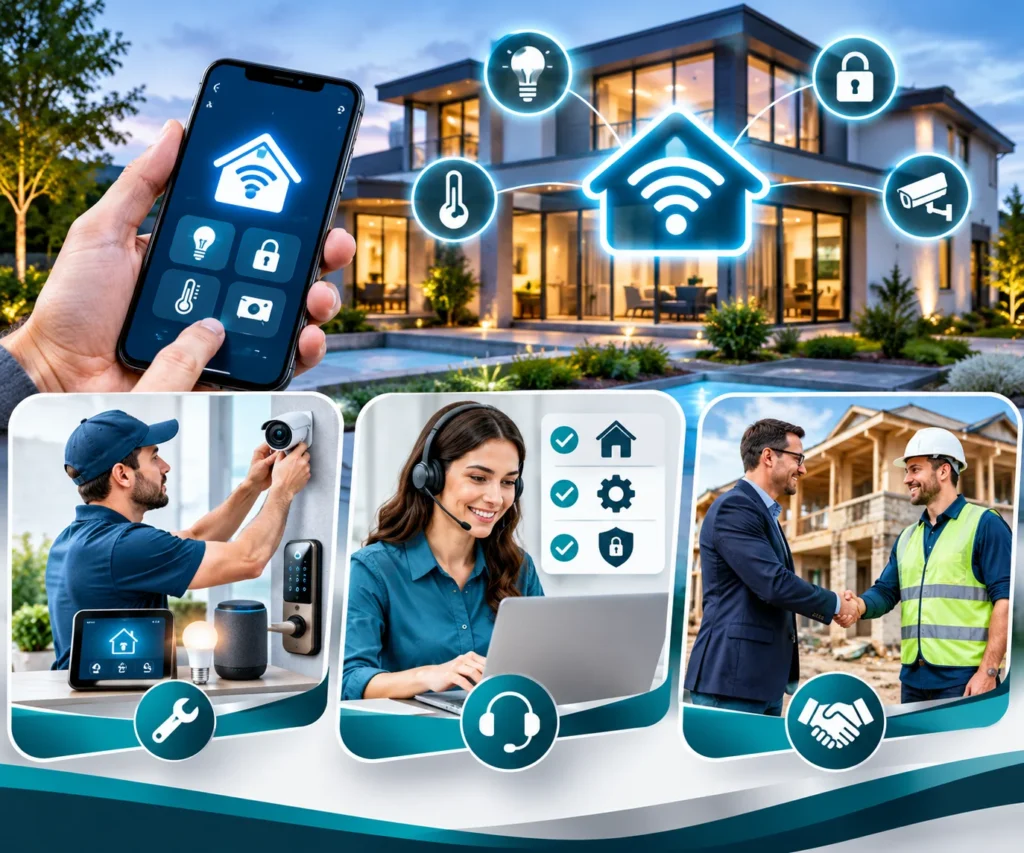
Common approaches include product sales, fixed-price projects, technical services, consultation, and recurring support agreements. The right combination depends on experience, cash flow, and target customers.
Project-Based Installation
A project-based smart home installation business charges for a defined scope, such as installing a lighting package, configuring a security system, or completing a network and automation project.
The proposal should separate equipment, labor, programming, testing, and any optional services.
Consultation and Design
A consultation-led business charges for needs assessments, system planning, product recommendations, or design documents.
Customers may then hire your team or another qualified contractor for installation. This can be a lower-inventory model, but the value of the advice and deliverables must be clear.
Ongoing Service Agreements
A smart home services business may offer scheduled system reviews, troubleshooting, remote support, or upgrade planning.
This creates the possibility of recurring revenue for smart home services, but agreements must state response times, included work, exclusions, and extra charges.
Your smart home business revenue model may combine project income with optional maintenance plans.
Explain third-party subscriptions separately so customers understand which charges go to your company and which go to manufacturers or service providers.
How Do You Start a Smart Home Business Step by Step?
Starting a home automation company requires business planning, technical preparation, supplier research, and a clear service scope.
Before buying inventory, identify target customers and problems your company can solve reliably.
Build a Practical Business Plan
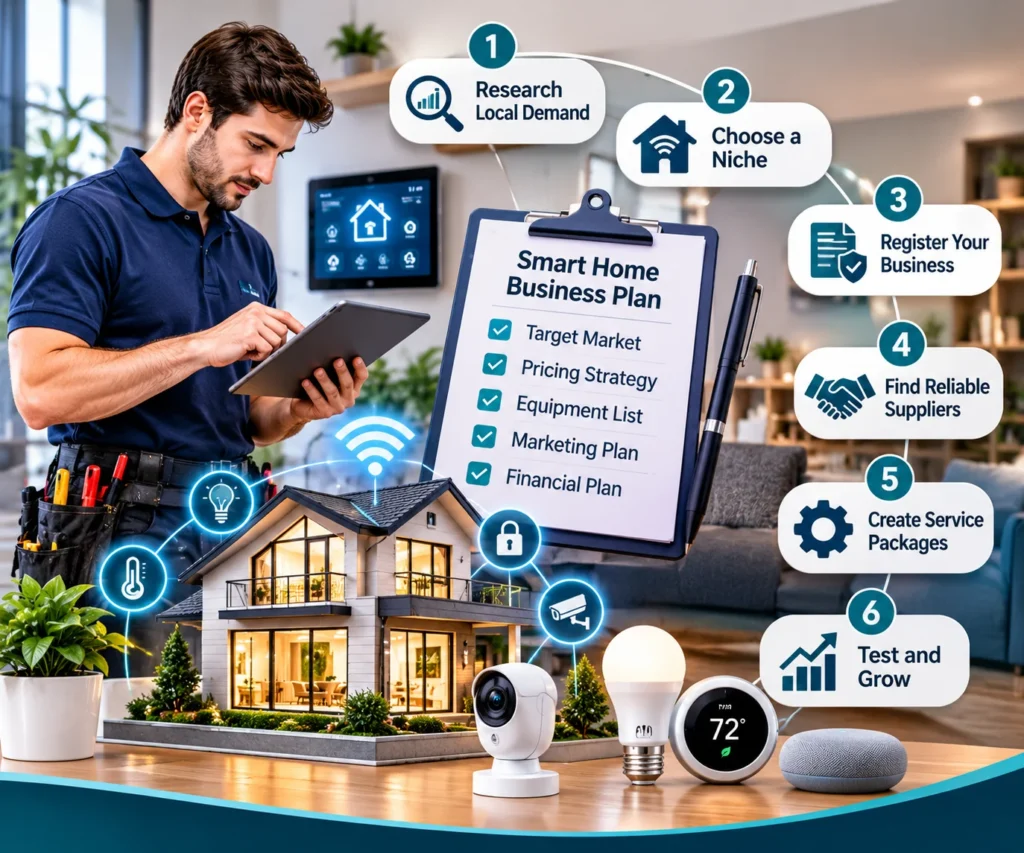
A smart home business plan should define your service area, customers, competitors, pricing, startup costs, equipment, and sales channels.
Include assumptions about project volume, labor hours, supplier payments, and the cash reserve needed before customer invoices are paid.
Follow a Structured Launch Process
- Research local demand and compare the services offered by competitors.
- Choose a launch niche that matches your skills and qualifications.
- Register the business and confirm applicable licensing, insurance, and tax requirements.
- Identify reliable smart home equipment suppliers and authorized distributors.
- Create written service packages, estimates, contracts, and handover documents.
- Test your workflow on appropriately scoped projects before expanding.
Define What Customers Receive
A clear proposal should explain the devices, installation tasks, compatibility assumptions, testing, training, warranty boundaries, and optional support.
The site’s smart home packages guide can help readers understand how connected-home equipment and service options may be grouped for customers.
Start with a manageable product range. Expand only when you can maintain installation quality, supplier access, customer support, and adequate working capital.
What Licenses, Insurance, and Certifications May Be Required?
Smart home business requirements depend on the state, city, and exact work being performed. There is no nationwide license that automatically authorizes every type of smart home installation.
General business registration is separate from trade-specific licenses, permits, and professional qualifications.
Check Local and Trade Licensing
A smart home business license may be required through state or local registration, while certain tasks trigger additional trade rules.
Electrical wiring, fixed switches, HVAC connections, alarm monitoring, security systems, and low-voltage cabling may be regulated differently across jurisdictions.
Before advertising or accepting regulated work, contact the relevant state licensing board and local permitting authority.
Confirm whether you need an electrical, contractor, alarm/security, or other specialty license, or whether the work must be subcontracted to a qualified professional.
Consider Certification and Insurance
A smart home installer certification can demonstrate technical knowledge, but a private credential does not replace a legally required license.
CEDIA offers credentials covering cabling and infrastructure, integrated systems, residential networking, and system design. Requirements and experience levels vary by credential.
Discuss general liability, commercial auto, tools and equipment, workers’ compensation, and professional coverage with a qualified insurance adviser.
The right policies depend on your contracts, employees, vehicles, and service scope. Maintain written procedures for site safety, customer permissions, and project documentation.
How Much Does It Cost to Start a Smart Home Business?
Smart home startup costs vary with the services offered and the equipment required.
A home-based consultation startup has a different cost structure from an installer handling wiring, security, networking, inventory, and whole-home projects.
Do not rely on a single generic startup figure.
Prepare a budget using actual local registration fees, supplier quotes, insurance estimates, training costs, and realistic operating expenses.
Separate one-time setup purchases from monthly overhead and job-specific costs.
| Cost category | What to budget for |
| Business setup | Registration, accounting, legal advice, and permits |
| Tools and testing | Installation tools, cable testers, network tools, and safety equipment |
| Inventory | Demonstration units, common devices, cables, and accessories |
| Training | Courses, certification preparation, and technical learning |
| Insurance and transport | Required coverage, vehicle costs, fuel, and maintenance |
| Marketing and software | Website, CRM, estimates, advertising, and payment processing |
| Working capital | Supplier payments, payroll, rent, and cash-flow reserves |
Calculate Your Break-Even Point
Estimate monthly fixed expenses and the average contribution from each completed project after direct labor and equipment costs.
Divide fixed expenses by that contribution to estimate how many similar projects you need to cover overhead.
This approach gives a more useful starting budget than copying another company’s costs. Update the calculation when supplier prices, wages, insurance, or customer demand change.
How Should You Price Smart Home Services and Build Revenue?
Smart home service pricing should reflect the work needed to assess, plan, install, configure, test, and support a system.
A quote based only on device count can underprice complex jobs that require network troubleshooting, programming, customer training, or coordination with other trades.
Select a Suitable Pricing Method
Fixed project pricing works when the scope and equipment are clearly defined.
Hourly pricing may suit diagnostics, troubleshooting, or work that cannot be estimated accurately before inspection.
Some providers price by room, device, or installation stage, but should still account for planning, travel, setup, testing, and documentation.
Make Quotes Transparent
List equipment, labor, configuration, programming, taxes, third-party subscriptions, and optional maintenance separately.
State assumptions about existing wiring, network coverage, and device compatibility. Explain what counts as additional work and how change orders will be approved.
For a reference to the customer-facing cost side of connected-home projects, see the site’s smart home technology quotes guide.
Develop a Sustainable Revenue Model
Your smart home business revenue model may combine project fees with optional inspections, support plans, and future upgrades.
Recurring services can improve revenue predictability, but only when the business can deliver the promised support at a sustainable cost.
Track gross margin, callbacks, quote acceptance, labor hours, and overdue invoices to identify which services are profitable.
How Can You Attract Customers and Build Partnerships?
Smart home customer acquisition starts with a clear explanation of the problems your company solves.
Homeowners may need better Wi-Fi, lighting control, security devices, or help connecting different brands.
Builders and property managers may need a partner who can coordinate work during construction or renovation.
Use Helpful, Specific Marketing
Marketing for home automation companies should focus on practical services and customer questions.
Create separate service pages for major offerings, explain the installation process, describe compatibility limitations, and provide realistic information about estimates and support.
Use project photographs, reviews, and case studies only when they are genuine and you have permission to publish them.
Build Local Referral Relationships
Partnerships with builders, remodelers, electricians, security contractors, interior designers, and property managers can create qualified referrals.
Agree in writing on lead ownership, installation responsibilities, customer communication, payment terms, warranty handling, and data access.
Improve the Sales Process
- Use an intake form to identify property type, requested service, current equipment, and project timeline.
- Arrange a site assessment when network coverage, wiring, or installation conditions need inspection.
- Provide a written estimate with scope, exclusions, timeline, and payment milestones.
- Follow up after completion to explain the system and request feedback without pressuring customers.
AI-assisted tools can help organize inquiries or draft follow-ups, but review technical claims and protect customer information before using them.
Measure qualified leads, quote acceptance, project margin, and referral sources. This helps you invest in channels that generate suitable work rather than traffic alone.
How Do You Manage Suppliers, Installation Quality, and Growth?
Reliable delivery depends on more than finding low-cost devices.
Evaluate smart home equipment suppliers and smart home distributors for product authenticity, stock, documentation, warranty handling, returns, training, and support. Confirm market authorization and replacement availability before selecting a supplier.
Standardize the Installation Process
Use a checklist for site assessment, compatibility confirmation, network testing, installation, configuration, security settings, customer training, and handover.
Record product models, firmware versions where useful, account ownership, and system settings securely.
This makes future maintenance and troubleshooting easier.
Protect Customer Trust
Explain what the installed system can and cannot do.
Do not promise that a camera prevents crime, that a sensor detects every problem, or that a connected device will work during every internet or power outage.
Provide manual alternatives for important functions and document any third-party subscriptions.
Expand in Stages
A growing company may add smart home integration services, maintenance agreements, or larger projects after proving it can deliver smaller jobs consistently.
The site’s smart home installation services guide provides more context on the service and installation process.
Track service callbacks, installation hours, customer satisfaction, and job margins before hiring or expanding into another area.
Sustainable smart home business growth comes from repeatable quality, capable staff, supplier reliability, and clear customer expectations.
What Challenges Should a Smart Home Business Prepare For?
Smart home business challenges include changing product ecosystems, inconsistent network conditions, complex installations, customer privacy, and price competition.
Devices may use different apps, protocols, hubs, and subscription models. A combination that works in one property may not behave the same way in another.
Technology and Compatibility Risks
Check each device’s exact model, platform support, required hub, network needs, and available features before including it in a proposal.
Avoid promising universal compatibility.
Keep a documented list of installed equipment and configuration details so future troubleshooting does not depend on memory.
Security and Privacy Responsibilities
Connected cameras, locks, sensors, and voice assistants can handle sensitive household information.
Use unique passwords, enable multifactor authentication where available, apply supported updates, control user permissions, and explain cloud storage or subscription settings.
Do not collect customer credentials unnecessarily or leave installer access active after handover.
Cash Flow and Service Quality
Supplier delays, callbacks, unplanned labor, and late customer payments can affect a small company quickly.
Use written scopes, deposits where lawful and appropriate, change orders, realistic project schedules, and reserves for operating expenses.
Avoid expanding into regulated work without the required qualifications.
A business that communicates limitations honestly and plans for support can differentiate itself through reliability.
The goal is not to eliminate every technical issue, but to manage risks before they become expensive customer disputes.
Frequently Asked Questions About Starting a Smart Home Business
Is a Smart Home Business Profitable?
It can be profitable when services match local demand, project estimates cover labor and equipment, and customer acquisition costs remain manageable.
Results depend on competition, qualifications, pricing, overhead, and service quality rather than market growth alone.
Do I Need to Be an Electrician?
Not every smart home service requires an electrician, but fixed wiring and certain electrical or HVAC tasks may require licensed professionals.
Check local rules and use qualified subcontractors when the project falls outside your authorization.
Is Smart Home Installer Certification Mandatory?
CEDIA and other industry credentials can demonstrate relevant technical knowledge, but they are not automatically legal licenses.
Verify the requirements for the work and location where the business operates.
Can a Smart Home Business Earn Recurring Revenue?
Yes. Maintenance reviews, troubleshooting plans, support agreements, and future upgrades may generate repeat revenue.
Define response times, covered tasks, exclusions, and additional charges before selling a recurring plan.
What Is a Good Service to Start With?
Choose a service that matches your current skills and local demand, such as network setup, lighting, security-device configuration, or consultation.
Expand only after you can deliver the service reliably, safely, and profitably.
Build a Smart Home Business Around Trust and Technical Skill
A sustainable smart home business starts with a clearly defined customer, a service that solves a real problem, and the qualifications needed to deliver it.
Research local demand before investing heavily in inventory, a showroom, or a large team.
Use a business plan with realistic pricing, operating costs, supplier terms, and cash-flow reserves.
Begin with a focused service range. Establish written processes for site assessments, compatibility checks, estimates, installation, testing, customer training, and aftercare.
Confirm licensing and permit requirements before performing regulated work, and use appropriately qualified partners when needed.
As the company grows, consider adding integration, maintenance, and upgrade services that complement the original offer. Measure project margins, callbacks, customer feedback, and repeat business before expanding into new categories or locations.
The strongest smart home technology business is not necessarily the one selling the most devices.
It is the one that makes connected technology easier to use, communicates limitations honestly, protects customer information, and provides dependable support after installation.