

Smart home technology quotes help homeowners understand the expected cost of connected devices, home automation equipment, installation, programming, and ongoing maintenance before committing to a project. The total price depends on the number of devices, the size of the property, the automation features required, the installation method, and the complexity of integrating different systems.
A basic setup with a few smart lights and plugs may cost far less than a professionally installed system that combines lighting, security, climate control, entertainment, and centralized automation. The most useful quote separates hardware, labor, programming, and additional charges so homeowners can compare proposals fairly and plan a realistic budget.
This guide explains home automation price ranges, the major factors behind project costs, regional pricing differences, and what to check before accepting a smart home installation estimate.
What Are Smart Home Technology Quotes?
Smart home technology quotes are estimates or proposals that describe the expected cost of purchasing, installing, configuring, or maintaining connected home equipment.
A quote may cover individual products, a collection of devices, or a complete home automation project. Depending on the provider, it can include hardware, installation labor, wiring, programming, system integration, testing, and after-installation support.
For example, a homeowner who wants smart lighting in several rooms may receive a quote for switches, controllers, installation, and configuration. Someone planning a larger project may need a more detailed proposal covering security cameras, smart locks, climate controls, network equipment, and automation routines.
The purpose of a quote is not simply to provide a final number. It should explain what the proposed system includes, what is excluded, and how the price was calculated.
Before comparing home automation quotes, identify the functions you need and the equipment already available in your home. This creates a clearer scope and reduces the risk of paying for unnecessary hardware or discovering unexpected installation charges later.
How Much Does Smart Home Automation Cost?
The cost of a smart home system varies significantly according to its scope. A small collection of connected devices may require only a modest initial investment, whereas a professionally integrated whole-home system can involve substantially higher hardware, labor, and commissioning costs.
For a broad U.S. planning reference, a 2026 Angi consumer cost guide reports smart home system costs of approximately 173–1,363 for its general project range, with a reported average of $765. Its categories also show that more extensive systems can cost several thousand dollars, while customized installations may be considerably more expensive.
These figures should not be treated as a universal installed price. Small projects, individual-device purchases, and professionally integrated whole-home projects have different scopes. A quote for one smart thermostat is not comparable to a quote for lighting, security, network infrastructure, and automation throughout an entire property.
Home Automation Price Range by Project Scope
The following table provides broad U.S. planning ranges reported in consumer cost guides for 2026. These are indicative estimates, not guaranteed installation prices or a standardized industry price list.
| Project Scope | Indicative U.S. Price Range | Typical Scope |
| Basic connected setup | 150–1,500 | A few smart devices and simple controls |
| Mid-range system | 2,000–6,000 | Multiple devices with basic integration |
| Advanced automation | 2,500–10,000+ | Broader integration and more complex controls |
The ranges overlap because system definitions, included equipment, and installation requirements vary across estimates. A professional whole-home system with specialized hardware, custom programming, and extensive integration may cost substantially more than these planning ranges.
For an accurate home automation system cost estimate, request a quote based on the actual property, required devices, installation conditions, and intended functionality.
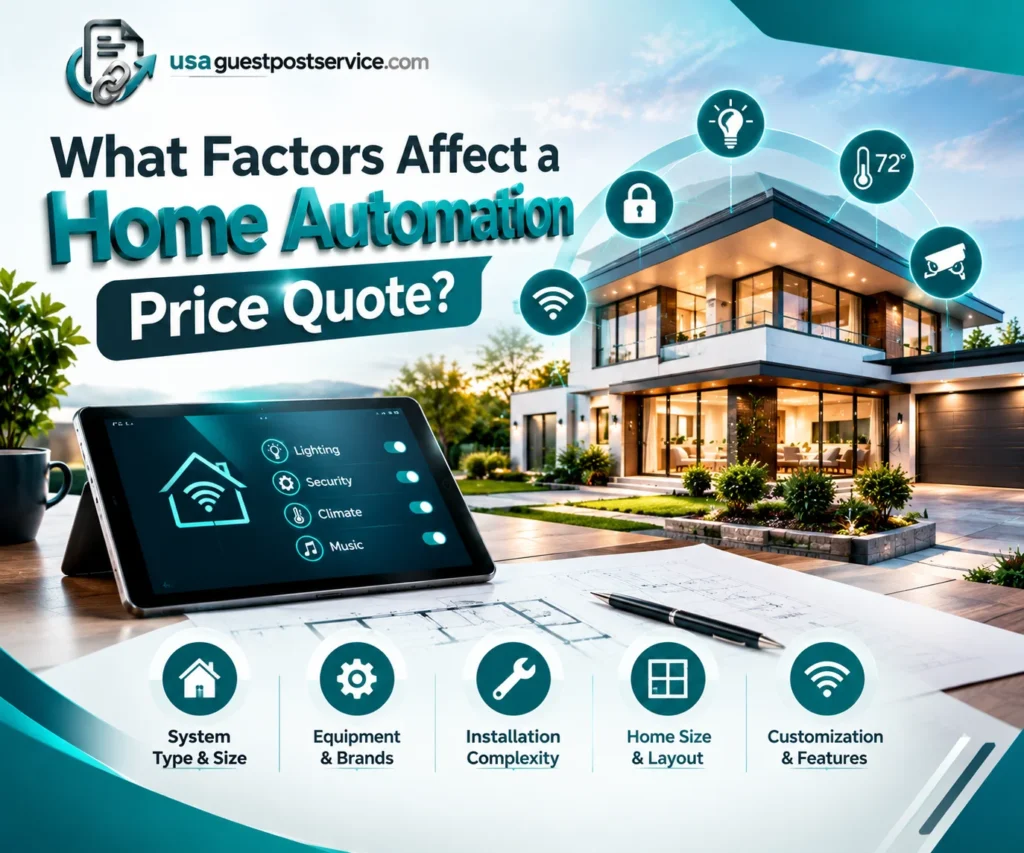
What Factors Affect a Home Automation Price Quote?
Two homes can receive very different quotes even when the homeowners request similar smart home technology. The difference often comes from the installation scope, existing infrastructure, equipment quality, and amount of integration required.
Number and Type of Devices
The number of devices directly affects hardware cost. A project involving a few smart lights and plugs needs less equipment than one that includes lighting controls, sensors, cameras, locks, thermostats, and motorized blinds.
Product features also matter. Entry-level devices may offer basic app control, while premium models can provide additional integrations, more advanced controls, or specialized capabilities.
When reviewing a home automation price list, check the exact model and quantity of every item. A proposal that simply lists “smart lighting” or “security system” without specifying the equipment makes meaningful price comparison difficult.
Property Size and Existing Infrastructure
Larger properties may require additional controllers, sensors, network equipment, wiring, or communication coverage. However, home size alone does not determine the price.
Existing wiring, switch arrangements, Wi-Fi coverage, equipment compatibility, access to installation points, and the condition of the property can also affect the work required.
A retrofit in an occupied home may involve different labor requirements from a system installed during new construction or a major renovation. The quote should explain whether the existing infrastructure can support the proposed equipment or whether modifications are needed.
Wired vs. Wireless Home Automation
Wired and wireless automation systems have different cost structures.
Wireless systems can be practical for retrofits because compatible devices may connect without extensive new control wiring. However, they still require suitable network coverage, configuration, and compatible equipment.
Wired systems may involve more planning, cabling, specialist installation, and commissioning. They can be appropriate for certain new builds or extensively integrated projects, but the benefits and costs depend on the design.
A useful home automation price comparison should evaluate the total installed system, reliability, compatibility, maintenance, and future expansion—not just the initial equipment price.
Labor and Installation Charges
Labor costs depend on the type of work and the time required. Installing a plug-in smart device is different from replacing electrical controls, running wiring, mounting security equipment, configuring a network, or coordinating multiple systems.
Professional installation may also include site assessment, device testing, troubleshooting, and handover instructions. Where licensed electrical work is required, the quote should identify the responsible qualified professional and any relevant compliance requirements.
A proposal with a lower initial total is not automatically the better option if it excludes essential installation work or leaves the homeowner responsible for additional setup charges.
Programming and System Integration
Home automation programming cost is another important part of a complex project. Programming and commissioning can involve configuring scenes, schedules, device groups, sensors, and interactions between supported systems.
For example, a homeowner may want a single routine to adjust selected lights and climate settings while activating designated security functions. Whether this can be achieved depends on the devices, controller, platform, and required integration work.
Simple setups may need minimal configuration, while customized installations can require more extensive programming, testing, and adjustments.
The quote should identify whether programming is included, how many routines or functions are covered, and whether additional changes after installation will incur extra charges.
What Should a Home Automation Price List Include?
A useful home automation price list separates the main project costs instead of presenting a single unexplained total. This helps homeowners understand where their budget will go and identify missing items before approving the work.
| Cost Category | What to Check |
| Hardware and devices | Exact products, quantities, models, and unit prices |
| Hubs and controllers | Required gateways, bridges, or central control equipment |
| Installation labor | Mounting, wiring, electrical work, and configuration |
| Programming | Scenes, schedules, routines, and system integration |
| Network preparation | Coverage improvements, network equipment, and setup |
| Taxes and additional charges | Applicable taxes, travel charges, permits, and other fees |
| Support and maintenance | Warranty terms, software support, subscriptions, and service visits |
Not every project will include every category. A small DIY installation may need little professional labor, while a complex system can involve additional design, commissioning, and support costs.
Ask the provider to mark items as included, optional, or excluded. That makes it easier to determine whether a proposal represents the complete installed cost or only the initial price of the equipment.
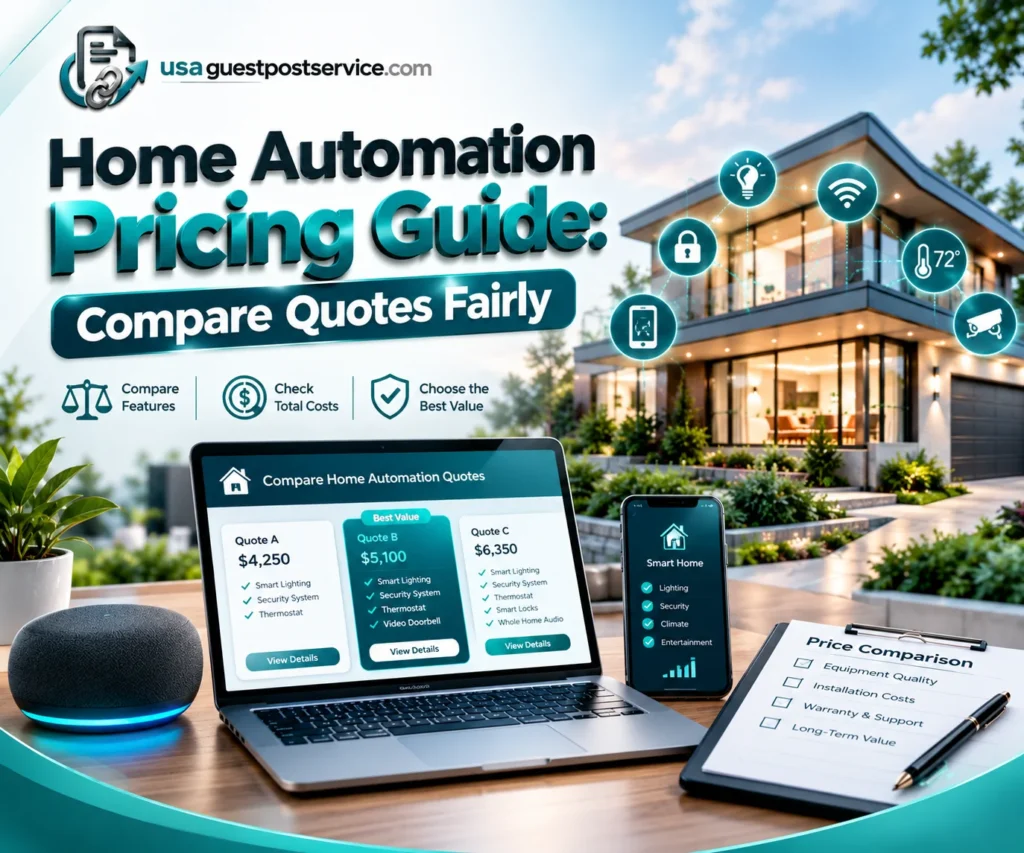
Home Automation Pricing Guide: Compare Quotes Fairly
A home automation pricing guide should help you compare proposals based on equivalent work. Looking only at the total can hide important differences in equipment, functionality, and service.
Start by requesting the same essential scope from each provider. Specify which rooms and devices you want included, what automation functions you expect, and whether you need professional installation or after-sales support.
Then compare the proposed products, quantities, installation requirements, programming, warranties, and exclusions. Check whether the provider has accounted for existing wiring and connectivity or whether those items may lead to additional costs after work begins.
For a detailed explanation of system design, installation stages, and integration requirements, read this smart home installation services guide.
A Practical Quote Comparison Example
Imagine two contractors quote for a smart home installation that includes lighting controls, a few sensors, security devices, and automation routines.
The first proposal may have a lower total because it includes basic equipment and limited setup. The second may cost more because it includes additional devices, installation labor, programming, system testing, and a defined support period.
To decide which quote provides better value, compare what each contractor will actually deliver. If the proposals do not include the same equipment and functions, the difference in total price does not establish which one is more economical.
A written comparison also helps identify missing work before installation begins. This is especially important when a project combines several technologies or requires changes to the existing electrical or network infrastructure.
Regional Home Automation Prices and Cost Comparisons
Home automation prices vary by country and city because equipment availability, import duties, taxes, labor rates, installation practices, and local standards differ. Currency conversion alone cannot make two quotations directly comparable.
Searches for home automation price in Bangalore and home automation price in Kerala reflect local Indian markets. A useful local quotation should clarify the system’s scope, the applicable taxes, installation labor, and whether wiring or other work is excluded.
Similarly, a home automation price in Pakistan may depend on available device brands, imported equipment, local installation rates, and any additional power or network requirements. Homeowners should compare proposals in Pakistani rupees and confirm what is included.
For South African projects, home automation price South Africa searches may cover anything from a small connected setup to a fully integrated property. The quote should specify equipment, installation, local travel, and any necessary backup-power provisions rather than assuming every property requires the same configuration.
A home automation Singapore price estimate should be assessed in Singapore dollars, with applicable taxes, hardware, labor, configuration, and service support clearly identified. The same principle applies to the home automation system cost UK and home automation system UK cost: confirm local currency, labor, taxes, and the actual scope before comparing providers.
For home automation system price in China, local product availability, integration requirements, installation arrangements, and the particular brands chosen can all affect the total.
Finally, home automation USA cost estimates should distinguish between individual devices, basic connected systems, professionally installed systems, and customized whole-home automation.
These regional keywords describe different markets, not interchangeable pricing standards. A reliable comparison uses current local quotations with clearly defined scope, currency, and inclusions.
Home Automation System Cost: Installed vs. Equipment-Only Prices
One of the most important distinctions in smart home technology quotes is whether the price covers equipment only or the complete installation.
An equipment-only quote might list smart switches, cameras, sensors, and a controller without including mounting, wiring, configuration, or testing. An installed-system quote should identify the installation work included, although the exact scope may still vary.
Before accepting a proposal, ask whether the price includes the following:
- Delivery and all required hardware.
- Installation, mounting, and any necessary wiring.
- Device pairing, programming, and testing.
- Taxes, permits, and other applicable charges.
- Handover instructions and any agreed support period.
The scope will depend on the project, so the list should be used as a verification checklist rather than an assumption that every item is required.
If electrical, structural, or other specialist work is necessary, confirm whether it is included in the quote or requires a separate contractor. This can prevent a seemingly inexpensive estimate from becoming more expensive once work begins.
Home Automation System Budget: Plan for Hidden and Ongoing Costs
A realistic home automation system budget should account for more than the initial purchase. Some costs arise before installation, while others continue throughout the life of the system.
Potential additional expenses include site assessments, network upgrades, subscription services, replacement devices, software support, and future expansion. Larger or more customized systems may also need additional programming or professional troubleshooting.
Home automation repair cost depends on the nature of the problem. A minor configuration issue may require limited troubleshooting, while a failed controller, damaged wiring, or an integration problem affecting several devices may require more extensive work.
Maintenance requirements should also be discussed before purchase. Ask what warranty coverage applies, whether support visits are included, and what happens if a device or platform stops receiving support.
Planning for these costs does not mean that every project will incur all of them. It means setting aside an appropriate allowance for the equipment and services the chosen system actually needs.
Home Automation Standards and Technology Cost Comparison
Home automation standards influence which products can communicate, what hardware is required, and how easily the system can expand. Compatibility can therefore affect both the initial project cost and the expense of future upgrades.
Wi-Fi devices may connect directly to a supported home network, while other products may use technologies such as Zigbee, Z-Wave, or Thread. Depending on the setup, an additional hub, controller, or bridge may be necessary.
Matter is an interoperability standard designed to help supported smart home products work across compatible ecosystems. However, Matter support does not guarantee that every product feature will work with every controller or other device.
A meaningful home automation standards cost comparison should consider the complete system rather than assuming one connectivity technology is always cheaper. Hardware requirements, integration, reliability, software support, and future compatibility all matter.
The best approach is to choose a system that supports your required functions and offers a reasonable path for maintenance and expansion. Buying the least expensive incompatible equipment can create additional replacement and configuration costs later.
Home Automation Using IoT: What Affects the Cost?
Home automation using IoT relies on connected devices that exchange information over supported networks or platforms. These devices may collect sensor readings, receive commands, send notifications, or participate in automated routines.
The cost of an IoT-based home automation project depends on the equipment, communication method, controllers, installation requirements, software configuration, and intended functions.
A small project involving a few wireless sensors and connected lights may require relatively little equipment. A broader project with centralized controls, several device categories, specialized networking, and customized automation may require substantially more planning and integration.
The important point is that IoT describes a broad category of connected technology, not a fixed price tier. A home automation quote should specify which devices, platforms, and functions are included rather than relying on the term “IoT” as a description of the complete system.
Home Automation Repair Cost and Programming Fees
Repair and programming fees should be considered separately when evaluating an existing installation or expanding a connected home.
Home automation repair cost may include diagnostic visits, replacement components, troubleshooting, reconnection of devices, or restoration of failed automations. The provider may charge a service-call fee, an hourly rate, or a fixed price for a defined repair.
Programming fees can also vary. Simple device pairing and routine adjustments may be straightforward, while complex integration can require more time to configure and test.
When requesting a repair quote, describe the problem, identify the affected devices, and explain whether the issue began after a network change, software update, or equipment replacement. This information may help the provider estimate the required work, although an in-person assessment may still be necessary.
Ask whether diagnostic charges will be applied toward the repair and whether replacement equipment, travel, or follow-up visits are included. A clear written scope makes it easier to control unexpected expenses.
How to Request a Smart Home Technology Quote
The quality of the quotation often depends on how clearly you describe the project. Before contacting an installer, identify the rooms to be included, the main functions you want, the devices already installed, and the control platform you prefer.
Provide available information about the property’s size, existing wiring, network coverage, and any constraints that may affect installation. You do not need to know every technical detail; a good provider should identify what requires further assessment.
Request an itemized estimate with the hardware, labor, programming, taxes, exclusions, warranty conditions, and expected installation stages clearly explained. If more than one contractor is involved, confirm who is responsible for coordinating their work.
The website’s smart home installation category provides a relevant starting point for exploring smart home installation topics. For projects that also involve entry monitoring or cameras, see the guides to home security installation and security camera installation.
If the proposal includes connected access controls, the smart lock installation section may also be relevant when reviewing the work required.
Before approving the quote, make sure you understand the equipment being supplied, the functions it is expected to provide, and the conditions under which additional charges could arise.
Common Mistakes When Comparing Home Automation Quotes
One common mistake is comparing total prices without checking the actual scope of each proposal. A quote that excludes installation or programming may appear cheaper than one that includes the complete setup.
Another mistake is overlooking compatibility. Devices that cannot communicate with the selected controller may require additional equipment or replacement, increasing the final cost.
It is also easy to underestimate ongoing charges. Subscriptions, maintenance visits, software support, network improvements, and future replacement equipment may affect the overall budget.
Finally, avoid relying on outdated pricing pages as if they represent today’s market. Search terms such as home automation systems 2019 cost may lead to old estimates that no longer reflect current product availability, labor rates, or installation requirements. Always check the publication date and seek an updated local quote.
Frequently Asked Questions About Smart Home Technology Quotes
What Should a Smart Home Technology Quote Include?
A useful quote should identify the required equipment, quantities, installation labor, programming, testing, taxes, exclusions, warranty conditions, and any agreed support. The details depend on the project, so confirm which services are included before accepting the proposal.
How Much Does a Home Automation System Cost Installed?
The installed cost depends on the devices, property, wiring, labor, integration, and system complexity. General consumer estimates provide a starting point, but a property-specific quote is needed to establish the actual cost of the intended installation.
Is a Home Automation Price List Enough to Plan a Budget?
A price list can help estimate equipment costs, but it may exclude labor, controllers, programming, taxes, and other installation expenses. Use it as a starting point and request a complete estimate based on your actual project requirements.
Why Do Smart Home Quotes Differ Between Contractors?
Contractors may propose different brands, devices, installation methods, programming services, warranties, or support arrangements. Compare itemized scopes and included functions rather than selecting a provider based only on the lowest total.
How Can I Reduce Home Automation Project Cost?
Prioritize the features that provide the most practical value, start with a manageable number of devices, verify compatibility, and plan future expansion. Comparing equivalent proposals can also reveal whether optional equipment or unnecessary work is increasing the budget.
Should I Choose DIY or Professional Smart Home Installation?
DIY setup can be suitable for straightforward consumer devices when you are comfortable following the manufacturer’s instructions. Professional installation may be useful for complex integration, specialist electrical work, extensive wiring, or systems that require detailed programming and commissioning.
Get a Clear Smart Home Technology Quote
Smart home technology quotes are most useful when they explain the complete scope and cost of a project. Device prices are only one part of the budget; installation, programming, network preparation, integration, taxes, and ongoing support may also affect the total.
Start by identifying the household functions you want to automate, then compare proposals that cover the same devices and services. Review connectivity, compatibility, warranty coverage, maintenance requirements, and the possibility of future expansion before making a decision.
For regional pricing, use current local estimates and compare them in the correct currency with taxes and installation requirements clearly stated. A transparent quotation makes it easier to plan your home automation system budget, avoid unexpected charges, and choose technology that provides useful long-term value.