

Smart home technology combines connected devices, communication networks, software platforms, sensors, automation, and digital controls to create a more responsive home environment.
The technology can support lighting, climate control, security, entertainment, appliances, access devices, and other household functions. What makes these products “smart” is not simply that they contain electronics, but that they can communicate, share information, or respond to digital commands.
Modern smart homes may use applications, voice interfaces, sensors, automation rules, and centralized controls to manage these technologies. In more advanced setups, different systems can also work together as part of a coordinated ecosystem.
The result is not necessarily a fully automated house. Instead, smart home technology gives homeowners additional ways to monitor, control, and manage selected parts of their home.
This guide explains what smart home technology is, how it works, the core technologies behind modern connected homes, where it is used, the role of automation and artificial intelligence, and what homeowners should consider before adopting it.
What Is Smart Home Technology and How Does It Work?
Smart home technology refers to connected devices and digital systems that allow homeowners to monitor, control, or automate selected household functions.
Traditional household devices generally perform their functions independently. A conventional light switch controls a light, while a standard thermostat allows temperature adjustments directly from the device.
Smart technology adds communication and digital control.
A connected light may be managed through an application, a thermostat may receive remote commands, a camera may send notifications, and a sensor may provide information that another compatible system can use.
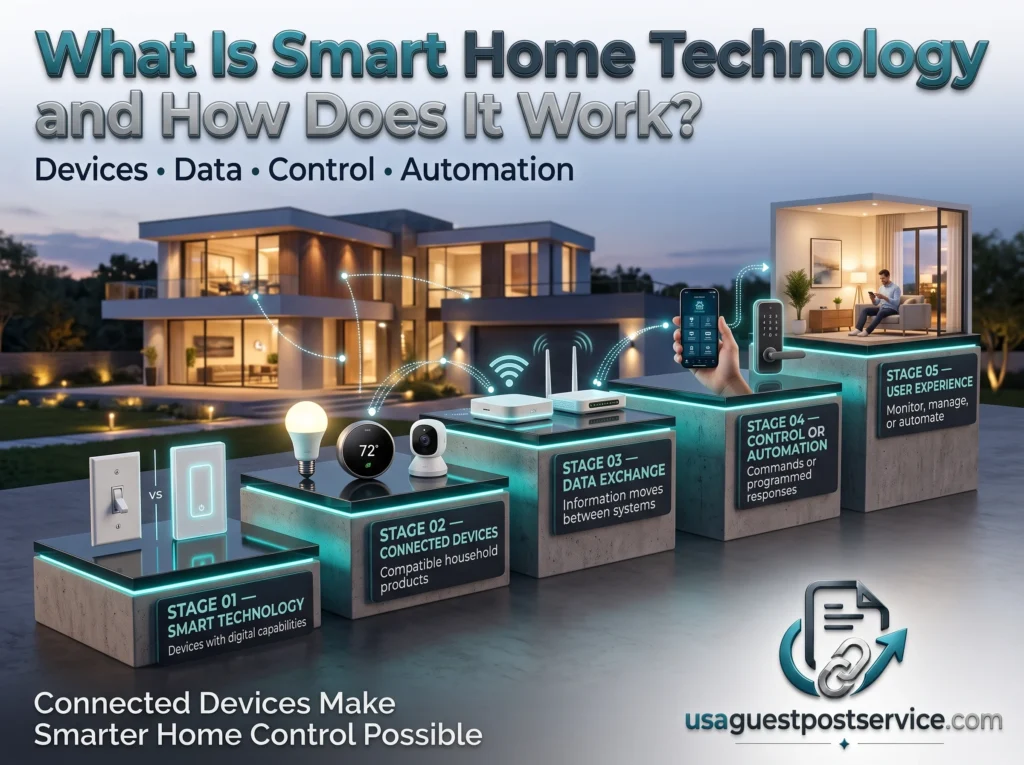
A simple way to understand the process is:
Smart Technology → Connected Devices → Data Exchange → Automation or Control → User Experience
The exact architecture varies between homes, but most smart home systems depend on the same broad elements: devices, communication, processing or control, and some form of user interaction.
Automation can be part of that process, but it is not required for every smart device. Some products mainly provide remote access or monitoring, while others can respond automatically to schedules, sensors, or programmed conditions.
The Core Technologies That Power Modern Smart Homes
Modern smart homes are built from several technology layers rather than one single system.
Connected devices provide the physical functions, sensors collect information, communication technologies move that information, and software or control platforms help users manage the environment.
The following table provides a quick overview.
| Technology Layer | Main Role | Examples |
| Connected Devices | Perform household functions | Lights, locks, thermostats, appliances |
| Sensors | Detect events or conditions | Motion, contact, temperature, leak sensors |
| Connectivity | Allows information to move between devices | Wi-Fi, hubs, bridges, supported wireless technologies |
| Control Platforms | Organize and manage compatible systems | Apps, hubs, controllers, smart home platforms |
| Automation and AI | Support automated or adaptive behavior | Routines, voice assistants, pattern-based features |
Internet of Things (IoT) and Connected Devices
The Internet of Things, commonly called IoT, describes physical devices that can connect to digital networks and exchange information.
In a smart home, IoT technology allows household products to become part of a connected environment rather than operating only as standalone devices.
Examples include smart lights, thermostats, locks, cameras, appliances, speakers, and other connected equipment.
A traditional light bulb produces light when electricity is supplied. A connected light can also receive digital commands, report its status, or participate in supported scenes and automation.
The same principle applies across many smart home products.
The important point is that IoT connectivity gives devices the ability to communicate. Whether that communication is actually useful depends on the platform, configuration, and purpose of the device.
Smart Sensors and Data Collection Technology
Sensors allow smart home systems to understand what is happening within the environment.
A sensor may detect motion, temperature, humidity, light levels, door or window status, water, occupancy, or another measurable condition.
That information can then be displayed to the homeowner, recorded by a connected system, or used by supported automation.
For example, a contact sensor can report whether a door is open or closed. A temperature sensor may provide information to a climate-control system. A motion sensor may support lighting or security functions.
Sensors are important because they allow smart home technology to respond to real conditions rather than relying only on manual commands.
Connectivity and Smart Home Networking
Connected devices need a reliable communication path.
Depending on the products involved, smart home technology may use the home network, dedicated wireless technologies, hubs, bridges, controllers, cloud services, or a combination of these methods.
The technical details can vary considerably, but homeowners do not need to understand every networking protocol to understand the basic principle.
If devices cannot communicate reliably, connected features may become inconsistent.
Network coverage, device placement, communication requirements, and system compatibility therefore become increasingly important as more smart technologies are added to the home.
Smart Home Automation Systems and Intelligent Control
Smart home automation allows connected technologies to perform selected actions automatically based on schedules, events, sensor information, or configured conditions.
A simple example is:
Sensor detects movement → System processes the event → Compatible light responds
Automation can also involve scheduled actions, climate settings, notifications, security-related events, entertainment systems, or other supported devices.
The important distinction is that automation describes what connected technologies do automatically, while smart home technology is the broader ecosystem that makes those actions possible.
A smart home may contain many connected devices without using extensive automation.
Similarly, an automation system depends on compatible devices, communication technologies, and software or controllers that can coordinate the required actions.
For a deeper explanation of triggers, conditions, actions, routines, and automation logic, our smart home automation guide covers that topic separately.
The Role of Artificial Intelligence in Smart Home Technology
Artificial intelligence can add another layer of software capability to certain smart home products and platforms.
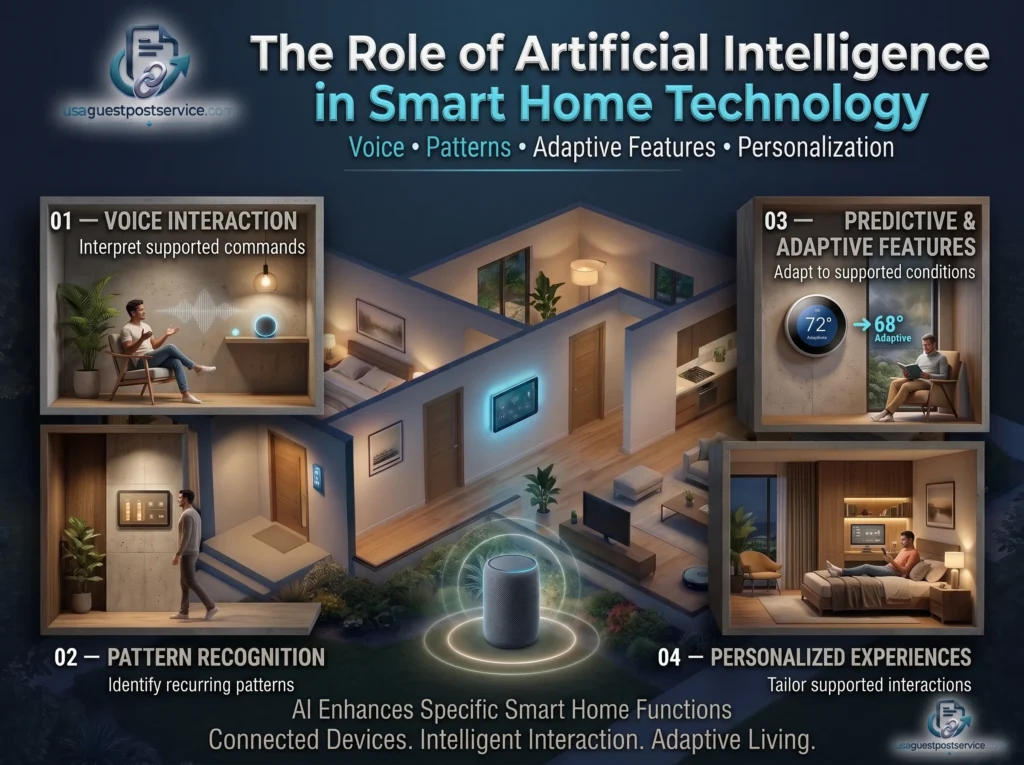
AI does not mean that a home independently controls every household function. In most cases, AI-related features are used for specific tasks such as interpreting voice commands, recognizing patterns, classifying events, or adapting certain settings.
Voice Interaction
Voice assistants use speech-processing technologies to interpret supported commands.
A homeowner may use voice interaction to control compatible lights, check device status, adjust settings, or access other connected functions.
The exact capabilities depend on the assistant, platform, and connected products.
Pattern Recognition
Some smart systems may identify recurring patterns in device use or household behavior.
For example, a platform may recognize commonly used settings or repeated interactions and use that information to provide suggestions or supported adaptive features.
This should not be confused with the system fully understanding the household.
Pattern-based features remain dependent on the data available, software design, and user configuration.
Predictive or Adaptive Features
Certain smart devices may use software models to make adjustments or recommendations based on historical information and supported conditions.
A climate system, for example, may use previous settings or occupancy-related information to improve how it manages comfort.
However, these capabilities vary between products and should not be assumed to exist in every smart home system.
Personalized Experiences
AI-assisted features may also help tailor interfaces, recommendations, voice responses, or device behavior around user preferences.
The practical value comes from making certain interactions more relevant or easier to manage, not from removing the homeowner from the decision-making process.
Types of Smart Home Technology Used Today
Smart home technology appears across several household systems, but the underlying technologies are often similar: connected devices, sensors, software platforms, communication networks, and digital controls.
The categories below show where those technologies are commonly applied rather than serving as a complete guide to individual smart-home products.
Smart Home Security Technology
Smart home security technology may include connected cameras, video doorbells, smart locks, contact sensors, motion sensors, and other supported monitoring devices.
These technologies can provide remote visibility, access controls, notifications, or system status information depending on the product and configuration.
Their role within a smart home is to add connected monitoring and control capabilities. They should still be treated as part of a broader home-security approach rather than as a guarantee of protection.
Smart Energy Management Technology
Smart energy-related technology may include connected thermostats, lighting controls, smart plugs, and energy-monitoring devices.
These products can provide additional information or control over selected household systems.
For example, homeowners may be able to adjust temperature settings remotely, schedule lighting, or review information from compatible monitoring devices.
Smart technology can improve awareness and control, but it does not automatically guarantee lower energy costs.
Smart Entertainment Technology
Smart entertainment technology includes connected televisions, speakers, streaming devices, displays, receivers, and multi-room audio systems.
These products may provide app-based control, voice interaction, shared media access, or integration with other compatible systems.
In a larger connected environment, entertainment devices may also participate in scenes or centralized controls.
Smart Convenience and Lifestyle Technology
Smart convenience technology includes products such as connected lighting, smart appliances, motorized shades, smart plugs, and voice-controlled devices.
These technologies are generally designed to make specific household tasks easier to manage or automate.
Their usefulness depends on whether the connected features solve a practical need. Adding connectivity alone does not necessarily make a device more valuable.
How Different Smart Home Technologies Work Together
Devices → Connectivity → Platforms → Automation/AI → User Experience
Modern smart homes work by connecting devices, networks, platforms, automation systems, and user interfaces into a coordinated technology stack.
Each layer supports the next.
Smart devices and sensors perform actions or collect information. Connectivity allows information to move. Control platforms organize supported technologies. Automation and AI may provide additional software-driven behavior. The user ultimately interacts with the system through applications, physical controls, voice interfaces, or other supported methods.
The relationship between these layers is where home technology integration becomes important.
Integration focuses on whether compatible systems can communicate and participate in the same connected environment.
A well-integrated smart home does not require every device to communicate with every other product. It requires the technologies that need to work together to have reliable and supported relationships.
Benefits and Practical Applications of Smart Home Technology
The practical value of smart home technology comes from what connected systems make possible rather than from the number of devices installed.
Different technologies can support remote access, environmental awareness, coordinated controls, accessibility, and automated responses. The actual benefit depends on the system design, compatibility, configuration, and household needs.
Convenience
Connected controls can reduce the need to interact manually with every device.
A homeowner may be able to adjust lighting, climate settings, entertainment equipment, or other supported functions from an application, voice interface, or shared control environment.
Remote Monitoring
Some connected products allow homeowners to view information or manage supported functions while away from home.
Examples may include reviewing camera feeds, checking device status, adjusting climate settings, or receiving sensor notifications.
Better Home Management
A connected environment can make it easier to understand and manage several household systems.
Rather than checking every device individually, homeowners may be able to access status information, controls, and notifications from a more organized interface.
Accessibility
Digital controls, voice interfaces, remote access, and automation can provide additional ways for people to interact with household technology.
Which features are useful depends on the individual household and user needs.
Automated Daily Routines
Smart home technology can also support repeated household routines.
Lighting, climate settings, security-related functions, or other compatible devices may participate in automated actions based on schedules, sensors, or selected conditions.
The best routines are usually those that solve a clear problem without making ordinary household functions harder to understand or control.
Important Factors Before Adopting Smart Home Technology
Smart home technology can become difficult to manage if products are selected without considering how they will fit into the broader system.
Before adding devices, homeowners should evaluate several practical factors.
A useful pre-purchase checklist includes:
- whether the device supports the preferred platform or controller
- whether it can perform the specific function the homeowner needs
- whether additional hubs, bridges, accounts, or subscriptions are required
- whether the home network can reliably support the device
- whether the product can fit realistic future expansion plans
- whether manual control remains practical if connected features are unavailable
Device Compatibility
Not every connected device works with every platform or ecosystem.
Compatibility may depend on the communication technology, software platform, product generation, controller, or specific feature involved.
Checking compatibility before purchase can help reduce fragmented controls and unnecessary replacements later.
Privacy Considerations
Connected devices may collect or process different types of information depending on their purpose.
Cameras, voice assistants, sensors, applications, and cloud services can all involve data handling.
Homeowners should review privacy settings, account permissions, device access, and the information a product collects or processes.
Network Reliability
Many connected features depend on stable communication.
Coverage, router placement, local network conditions, and device requirements can influence performance.
A high-speed internet plan alone does not guarantee good smart-home performance if device connectivity is poor within the property.
Scalability and Future Expansion
A homeowner may begin with only a few devices and later decide to add security, climate control, entertainment, sensors, or other systems.
Choosing technologies that can support realistic future additions can make expansion easier.
That does not mean trying to predict every future smart-home product. It means avoiding decisions that unnecessarily limit the system.
Technology Selection
The best smart home product is not necessarily the one with the longest feature list.
Homeowners should prioritize reliability, compatibility, usability, and the functions they actually need.
For readers ready to move from technology research to implementation, our how-to set up a smart home guide provides a more practical step-by-step planning framework.
Smart Home Technology: Standalone Devices vs Connected Ecosystem
This distinction is useful because smart home technology can exist at very different levels of complexity.
| Area | Standalone Smart Device | Connected Smart Home Ecosystem |
| Scope | Usually focuses on one function | Coordinates several household functions |
| Control | Often uses its own app or interface | May use shared platforms or centralized controls |
| Communication | May operate independently | Multiple compatible technologies can exchange information |
| Automation | Usually limited to product-specific features | Can involve several devices or systems |
| Planning | Relatively simple | Requires more attention to compatibility and connectivity |
| Expansion | Easy for individual products | Benefits from broader system planning |
Neither approach is automatically better.
A homeowner who only wants remote thermostat control may not need a larger connected ecosystem. A household that wants lighting, security, climate control, and other technologies to work together will need more planning.
The Future of Smart Home Technology
Smart home technology continues to develop as connected devices, software platforms, automation tools, and artificial intelligence capabilities evolve.
The most realistic direction is not necessarily a future where homes operate independently.
Instead, development is likely to focus on making connected technology easier to use, more compatible, and better able to support household preferences.
Better Device Integration
Improved interoperability can make it easier for compatible products from different manufacturers or ecosystems to participate in connected environments.
However, homeowners should still verify actual feature support rather than assuming every product can perform every function with every platform.
More Capable Automation
Automation systems may continue to provide more flexible ways to combine sensor information, schedules, device states, and household preferences.
The challenge will remain keeping these systems understandable and reliable.
AI-Assisted Experiences
AI may continue to support areas such as voice interaction, pattern recognition, event classification, recommendations, and adaptive features.
These capabilities should be viewed as tools that support specific household functions rather than as autonomous control of the entire home.
More Connected Living Environments
As more household technologies become connected, homeowners may have more opportunities to coordinate lighting, climate control, security, entertainment, appliances, and other systems.
The value of that connectivity will still depend on whether it makes the home easier to manage.
Frequently Asked Questions About Smart Home Technology
What is smart home technology?
Smart home technology includes connected devices, communication systems, software platforms, sensors, controls, and automation tools that allow homeowners to monitor, manage, or automate selected household functions.
How does smart home technology work?
Smart home technology works by allowing devices and sensors to exchange information through supported communication systems.
Platforms, controllers, or software can then use that information to provide user controls or carry out supported automated actions.
What are examples of smart home technology?
Examples include smart lighting, thermostats, cameras, locks, sensors, connected appliances, smart speakers, displays, entertainment systems, and other connected devices.
Can smart home technology be added to existing homes?
Yes.
Many smart devices can be added gradually to existing homes without replacing every household system at once.
The exact installation requirements depend on the product, existing infrastructure, network conditions, and whether specialist electrical, HVAC, security, or other work is required.
Is smart home technology the same as home automation?
No.
Smart home technology is the broader category that includes connected devices, sensors, platforms, controls, and communication systems.
Home automation is one capability within that broader technology environment.
Does smart home technology require artificial intelligence?
No.
Many smart home devices and systems operate through connectivity, software controls, schedules, sensors, or predefined automation without relying on advanced AI features.
Artificial intelligence is used in some products for specific capabilities such as voice interaction, pattern recognition, or adaptive features.
Do all smart home devices work together?
No.
Compatibility depends on the devices, platforms, communication technologies, controllers, and specific features involved.
Homeowners should verify the functions they want to use before assuming two smart products can work together.
Conclusion: Understanding Modern Smart Home Technology
Smart home technology combines connected devices, sensors, communication systems, software platforms, automation, and user controls to create a more responsive living environment.
The technology can support many areas of the home, from lighting and climate control to security, entertainment, appliances, monitoring, and accessibility.
More advanced systems may also use automation, integration, or AI-assisted features, but these capabilities should serve practical household needs rather than add unnecessary complexity.
For homeowners, the most useful approach is to understand the technology layers first, choose compatible products, maintain reliable connectivity, and expand the system only when new technology provides a clear benefit.
Modern smart homes work best when the technology feels coordinated and understandable—not when the home simply contains the largest possible number of connected devices.