
Searching for smart home installation near me usually means a homeowner is considering professional help but wants to understand the process before choosing someone.
A smart home installation can involve physical installation, device configuration, system integration, testing, and a final handover. The exact scope depends on the property, the equipment, and how many systems need to work together.
Before comparing local installation options, it helps to understand what the project should include, which responsibilities need to be defined, what questions to ask an installer, and what a complete handover should leave you with.
This guide focuses on those decisions. It does not attempt to replace a full smart-home setup guide or product-selection guide.
What Is Smart Home Installation and What Does It Include?
Smart home installation is the process of installing and configuring connected technology so it performs the functions agreed for the home.
The work may be simple or complex.
Installing one supported plug-in device may require little more than positioning it, connecting it to an account, and confirming that it works. A larger project may involve several devices, different rooms, multiple platforms, specialist building work, automation, and a more formal testing and handover process.
For homeowners comparing installation options, it is useful to separate four parts of the work.
| Part of the Project | What It Usually Covers |
| Physical installation | Positioning, mounting, powering, or connecting equipment |
| Configuration | Accounts, permissions, device names, notifications, and settings |
| Integration | Making supported devices or systems work together where required |
| Testing and handover | Confirming agreed functions and transferring practical control to the homeowner |
This distinction matters because two installers may both describe their work as “smart home installation” while offering very different scopes.
One may install the hardware only. Another may also configure accounts, create automations, test the system, provide documentation, and support the homeowner after installation.
Understanding the scope is therefore more important than relying on the service name alone.
What Should You Consider Before Smart Home Installation Near Me?
Before contacting an installer, decide what you actually want the completed system to do.
The purpose may be simple, such as controlling selected lights, receiving front-door notifications, or adjusting temperature more conveniently. A larger project may involve several systems that need to operate together.
The goal does not need to be highly technical. It needs to be specific enough that an installer can understand what outcome is expected.
For example, “I want a smart home” is difficult to scope. “I want front-door access, selected lighting controls, two cameras, and temperature control available from one main system” gives much more useful direction.
A homeowner should also identify existing equipment that may affect the project. Existing routers, thermostats, switches, locks, cameras, hubs, and connected devices can influence what new equipment will work with the home.
Detailed compatibility, network preparation, platform selection, Matter, Thread, hubs, and device-selection questions belong more naturally in a complete setup resource. If you are still planning those parts of the project, use our smart home setup guide before finalizing the installation scope.
For this stage, the more important question is who will be responsible for what.
A clear project brief should answer these questions:
| Project Question | Why It Matters |
| What should the finished system do? | Defines the expected outcome |
| Which equipment is already in the home? | Helps identify integration or replacement issues |
| Who supplies the devices? | Prevents purchasing and warranty confusion |
| Who performs physical installation? | Clarifies responsibility for the hardware |
| Who handles configuration? | Establishes who sets up accounts, permissions, and controls |
| Who performs specialist work? | Identifies electrical, HVAC, plumbing, security, or other qualified work |
| Who owns the main account? | Protects long-term homeowner control |
| Who tests the finished system? | Creates a clear completion standard |
| Who provides support afterward? | Prevents responsibility gaps after installation |
This responsibility map gives homeowners a much stronger starting point than simply asking how much an installation costs.
What Happens During a Professional Smart Home Installation?
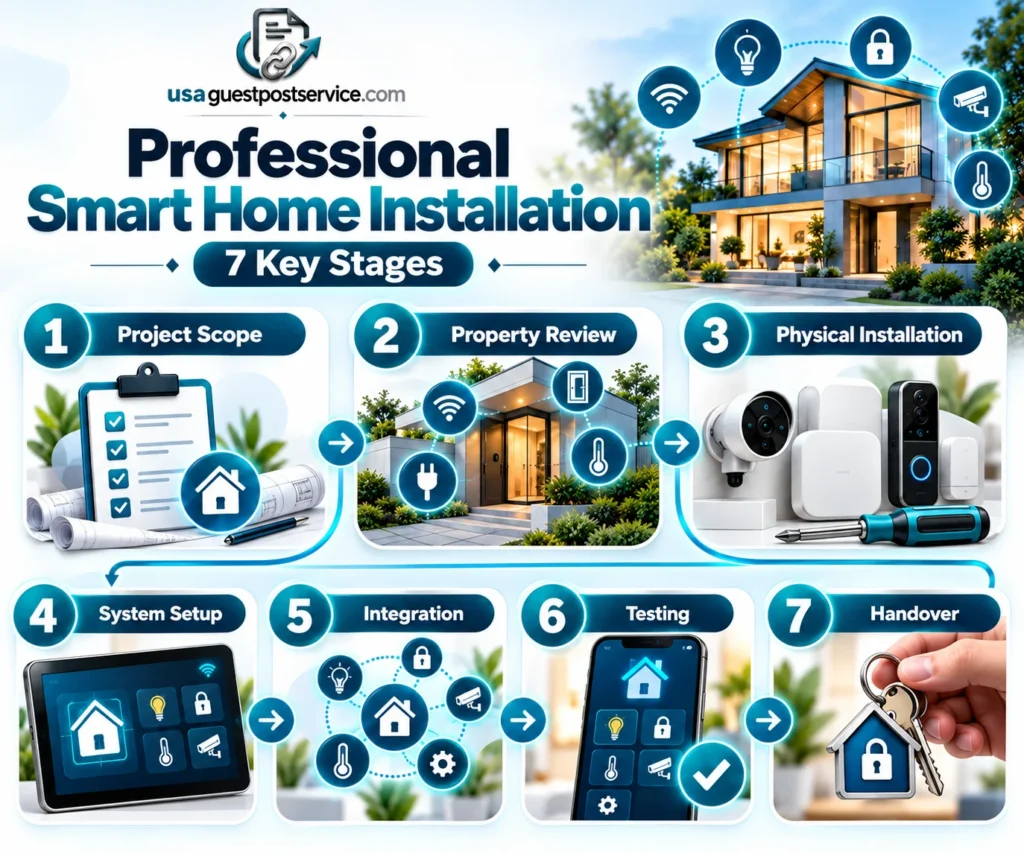
Professional smart home installation does not follow one universal procedure, but a well-defined project commonly moves through several stages.
The important point is not whether an installer follows a particular branded process. It is whether the agreed work is clearly defined, completed, tested, and handed over in a way the homeowner understands.
Confirming the Project Scope
Before installation begins, the installer and homeowner should confirm what the project includes.
That may cover the equipment, installation locations, physical work, configuration tasks, expected integrations, household access, testing requirements, and handover responsibilities.
The scope should be specific enough that both sides understand what “complete” means.
For example, installing a smart lock physically is different from installing it, adding it to the homeowner’s account, configuring household users, testing backup access, and demonstrating operation.
That distinction is important when comparing professional installation options.
Reviewing the Property
The planned equipment locations should be checked before permanent installation.
Real conditions can affect what is practical. Mounting surfaces, available power, existing controls, network conditions, door dimensions, heating equipment, and access for future maintenance may all influence the final installation.
The installer may therefore recommend changing a location or adjusting the proposed scope before the equipment is permanently fitted.
This stage should solve practical installation problems rather than become another complete smart-home planning exercise.
Completing the Physical Installation
The physical work may involve mounting, positioning, powering, or connecting equipment.
Some smart-home products require very little physical work. Other projects may interact with fixed electrical systems, heating and cooling equipment, plumbing components, access systems, or building structures.
The professional handling each task should match the work involved.
A person who is skilled at configuring smart-home software is not automatically qualified to perform every electrical, HVAC, plumbing, structural, or regulated security task. Requirements can also vary by jurisdiction.
For homeowners, the key question is simple:
Who is responsible for each specialist part of the project?
Configuring the System
After the physical installation, devices may need to be added to the appropriate accounts, named correctly, assigned to rooms, given suitable permissions, and configured for agreed notifications or controls.
Account ownership deserves particular attention.
The homeowner should understand which account controls the main system, who has administrator permissions, and whether any temporary installer access will remain after the project.
A smart home can be technically functional while still creating long-term problems if the homeowner does not control the accounts needed to manage it.
Integrating the Agreed Functions
Where supported devices need to work together, the installer may configure integrations or automations.
The focus should remain on the functions included in the project scope.
If the homeowner asked for a certain sensor to trigger a certain light, that function should be tested. If several devices should appear in one control system, that should be confirmed.
There is little benefit in adding complicated automation simply because it is possible.
A system that household members can understand is often easier to maintain than one filled with unnecessary rules.
Acceptance Testing
Testing is one of the most important parts of professional installation.
An installation should not be considered complete simply because every device appears online.
The agreed functions should work.
If the project includes door notifications, test the notifications. If it includes selected lighting controls, test those controls. If an automation is part of the scope, test its trigger and result.
The homeowner should ideally participate in this process.
Acceptance testing creates a practical standard:
Does the finished installation do what was agreed?
That is more useful than relying only on the installer saying the equipment has been installed successfully.
Final Handover
The final stage should transfer practical control of the system to the homeowner.
A useful handover explains how important functions operate, how household members receive access, who owns the main accounts, what information should be retained, and where the homeowner should go for future support.
The difference between installation and handover is important.
Installation makes the system work.
Handover helps make sure the homeowner can continue using and managing it.
Which Smart Home Systems and Devices Can Be Installed?
Smart home installation can cover many types of connected equipment, but this article does not need to duplicate a full device-selection guide.
For homeowners evaluating installation help, the more useful distinction is how the type of project changes the installation responsibility.
| Project Type | Main Installation Concern | When Additional Expertise May Matter |
| Smart lighting | Power, switches, controls, and compatibility | Fixed wiring or larger lighting systems |
| Smart thermostats | Existing HVAC controls and system compatibility | Changes involving heating or cooling equipment |
| Smart locks and access | Door fit, power, backup access, and permissions | Integration with broader access or security systems |
| Cameras and doorbells | Placement, power, network coverage, and privacy settings | Difficult mounting or wider surveillance systems |
| Sensors | Correct positioning, alerts, batteries, and testing | Integration with shutoff devices or other building systems |
| Whole-home integration | Coordination between multiple technologies | Larger projects involving several systems or specialist trades |
The exact requirements depend on the products and property.
Homeowners should use manufacturer information for model-specific installation requirements rather than assuming all products in the same category work the same way.
DIY Smart Home Installation vs Professional Installation
Some smart-home projects can be suitable for DIY installation, while others benefit from professional help.
The useful dividing line is not whether a device is described as “smart.” It is the complexity and responsibility involved.
A straightforward consumer device with clear instructions may be manageable for a homeowner who is comfortable configuring it. A project involving several systems, difficult mounting, specialist physical work, or complex integration may require additional expertise.
| Situation | DIY May Be Practical | Professional Help May Be More Appropriate |
| Straightforward consumer device | Clear instructions and no specialist work | Homeowner cannot confidently configure or troubleshoot it |
| Several connected devices | Homeowner understands the platform and responsibilities | Integration becomes difficult to plan or maintain |
| Whole-home system | Homeowner has suitable technical ability | Several rooms, systems, or professionals need coordination |
| Specialist building-system work | Ordinary device setup remains separate | Qualified expertise may be needed for the underlying work |
| Difficult physical installation | Equipment can be installed safely | Height, structure, access, or environment increases difficulty |
Professional installation should not automatically be treated as better than DIY.
The right approach depends on the task.
A combined approach can also work. A qualified professional may perform specialist physical work while the homeowner manages ordinary controls and personal account settings.
Whatever approach is chosen, the responsibilities should remain clear.
How to Evaluate a Smart Home Installer Near You
When evaluating a smart home installer near you, focus on whether the professional can clearly define and complete the project you actually need.
Location matters because the installer must be able to work at the property, but proximity alone does not show whether someone has the right experience.
A practical evaluation should focus on six areas.
| Evaluation Area | What the Homeowner Should Understand |
| Project scope | Exactly what is and is not included |
| Responsibility | Who handles physical work, configuration, and specialist tasks |
| Relevant experience | Whether the installer has completed comparable types of projects |
| Account ownership | Who controls administrator access after installation |
| Acceptance testing | How the completed functions will be checked |
| Handover and support | What the homeowner receives and who handles future problems |
Start With a Clear Project Scope
A written or clearly documented scope makes it easier to compare different installation approaches.
It should identify the important equipment, work being performed, responsibilities, expected functions, testing, and handover.
This prevents situations where the homeowner assumes integration or configuration is included but the installer considers the job complete after physical installation.
Match Experience to the Project
Ask about experience that resembles the work being planned.
Installing a few consumer devices is different from coordinating lighting, climate controls, security equipment, access devices, and automations across a property.
The important question is not simply:
“Are you a smart home installer?”
A better question is:
“Have you completed projects with this type of scope and responsibility?”
Professional memberships or certifications can provide useful background information, but no single badge should be treated as a guarantee that an installer is suitable for every project.
Define Who Handles Specialist Work
Some projects involve more than one professional.
For example, one person may handle device configuration while another performs qualified electrical or HVAC work.
Before work begins, determine who is responsible for each part and who coordinates the final system after specialist work is complete.
This avoids a common responsibility gap in which each party assumes someone else will finish the integration.
Confirm Account and Administrator Ownership
The homeowner should understand who owns the main accounts and administrator access.
After installation, the homeowner should not depend unnecessarily on the original installer for ordinary household management.
The system should allow the responsible owner to manage household users, change appropriate settings, replace equipment, and continue operating the home if the installer relationship ends.
Temporary professional access can be useful during setup, but the final access arrangement should be clear.
Agree on Acceptance Testing
Ask how the installer will demonstrate that the project is complete.
Instead of accepting a general statement that “everything works,” connect testing to the agreed scope.
If the project promised particular controls, notifications, integrations, or automations, those functions should be demonstrated.
This gives both the homeowner and installer a clearer completion point.
Understand the Handover and Support Plan
Ask what happens after testing.
The homeowner should understand how normal controls work, what system information will be provided, who handles future configuration questions, and who is responsible if a physical component fails.
The strongest installer evaluation therefore follows this sequence:
Scope → Responsibility → Relevant Experience → Account Ownership → Acceptance Testing → Handover → Support
This keeps the decision focused on the actual installation rather than relying only on proximity, marketing claims, or generic reviews.
Common Smart Home Installation Mistakes to Avoid
For this type of project, the most important mistakes are usually not about choosing the wrong smart bulb or learning every technical standard. They are about leaving responsibility unclear.
Starting Without a Defined Scope
When the scope is vague, the homeowner and installer may have different expectations about configuration, integration, testing, and support.
Define what the system should do and what work is included before installation begins.
Leaving Responsibility Between Professionals Unclear
A project can involve an installer, electrician, HVAC professional, security specialist, or another trade.
Problems arise when nobody knows who is responsible for the final connection between those areas.
Assign responsibility before work starts.
Letting Account Ownership Remain Unclear
A completed installation should not leave the homeowner unsure who owns the main account or administrator permissions.
Clarify account control during configuration and confirm it during handover.
Treating Device Connectivity as Completion
A connected device is not necessarily a completed project.
The functions agreed in the project scope should be tested.
A camera appearing online is different from confirming that the correct household member receives the intended notification.
Skipping a Proper Handover
If the installer leaves without explaining controls, access, recovery, documentation, or future support, the system may become difficult to manage later.
The homeowner should know enough to operate the important functions without depending on the installer for every routine task.
Leaving Future Support Undefined
Some problems belong to the device manufacturer. Others may involve physical installation, network configuration, platform integration, or specialist building work.
A clear support arrangement helps the homeowner know where to start when something goes wrong.
What Should You Expect After Smart Home Installation?
After installation, the homeowner should be able to use the agreed functions, control appropriate accounts, understand basic maintenance responsibilities, and know where to obtain support.
The post-installation stage can be viewed through three ideas:
Control
The homeowner should have appropriate access to the system and understand how normal functions operate.
That includes knowing how household members receive access and who controls administrator permissions.
For personally owned systems, the homeowner or responsible household member should generally retain appropriate control of the main accounts, depending on the platform and project arrangement.
Documentation
Keep the information that will make future maintenance easier.
This may include relevant model information, setup details, installer records, warranties, account-recovery information, and other project documentation.
Sensitive passwords should be stored securely rather than placed casually in installation paperwork.
Support
The homeowner should know who to contact when assistance is needed.
A manufacturer may handle a product fault. An installer may handle installation-related issues. Another professional may be responsible for electrical, HVAC, plumbing, security, or other specialist work.
Knowing these boundaries can make future troubleshooting much easier.
Connected-device maintenance also continues after installation. Security guidance from the Federal Trade Commission recommends practices such as changing default credentials, enabling two-factor authentication when available, installing updates, and disabling unnecessary features.
NIST also publishes consumer IoT cybersecurity guidance, reinforcing that connected-device security should remain an ongoing consideration rather than ending when installation is complete.
Frequently Asked Questions
How long does smart home installation take?
There is no universal installation time. A project’s duration depends on the equipment, property, physical work, number of systems, configuration requirements, testing, and whether specialist trades are involved.
A project-specific scope is more useful than a generic estimate because installing one consumer device and integrating several home systems are very different jobs.
Should I buy smart devices before contacting an installer?
Not always.
If the project is simple and you already understand the compatibility requirements, purchasing equipment first may be reasonable. For larger or more integrated projects, discussing the intended system before purchasing every device can help identify compatibility, installation, or responsibility issues earlier.
Should the homeowner own the main smart-home account?
For a personally owned system, the homeowner or responsible household member should generally retain appropriate control of the main account and administrator permissions, subject to the specific platform and project arrangement.
That makes it easier to manage household access, change support providers, replace equipment, and maintain long-term control of the system.
Can an installer make incompatible smart devices work together?
Not necessarily.
Integration depends on the actual devices, platforms, supported technologies, software features, and intended functions. An experienced installer may identify alternative approaches, but professional installation cannot guarantee that fundamentally incompatible products will gain unsupported capabilities.
Can a professionally installed smart home be expanded later?
Often, but expansion depends on the original system design, platform, equipment support, network capacity, and the products being added.
If future expansion is important, mention it during the initial planning stage so the installation can be evaluated with that goal in mind.
Make the Installation Scope Clear Before Choosing Help
Searching for smart home installation near me should lead to more than finding the nearest person who installs connected devices.
The homeowner first needs to understand the project.
Define the outcome. Clarify who handles physical installation, configuration, specialist work, accounts, testing, handover, and future support. Then evaluate whether a prospective installer has experience that matches those responsibilities.
A successful project is not simply one where the devices turn on.
The stronger result is a system that performs the agreed functions, has been properly tested, and can be understood and controlled by the homeowner after the installation is finished.
For broader planning topics outside this article’s installation-focused scope, explore our smart home guides.
This version creates a clearer separation:
Existing setup guide: planning, compatibility, networking, devices, Matter/Thread, automation, troubleshooting.
This article: installer search context, project scope, professional workflow, responsibilities, DIY/professional threshold, installer evaluation, acceptance testing, handover, and support.
That distinction should materially reduce the cannibalization risk between the two pages.