
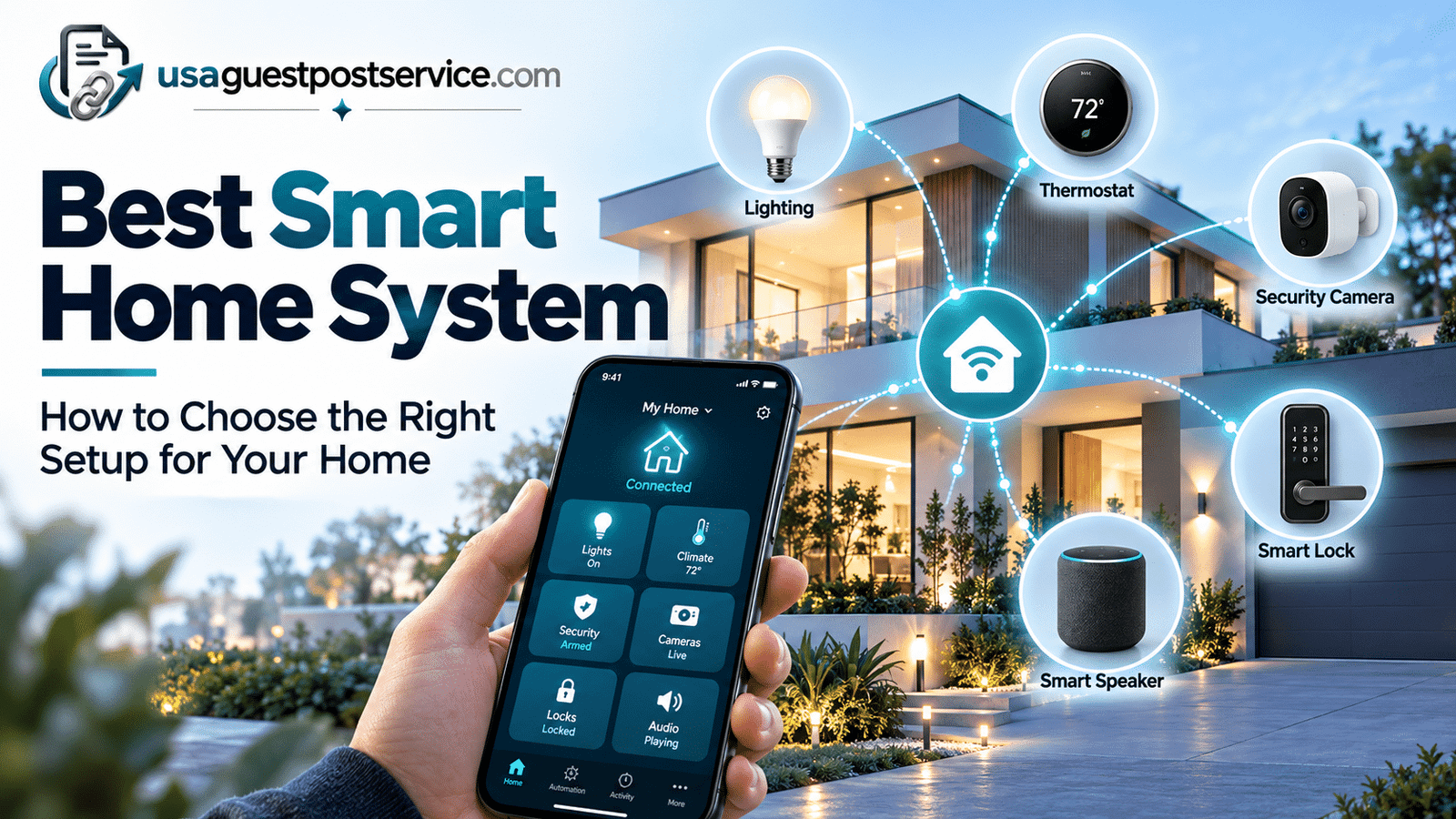
The best smart home system is not necessarily the one with the most devices, the most automation, or the longest feature list.
A good system is one that fits the household.
That means the devices work together in the ways you expect, controls are easy to use, automation solves useful problems, privacy and security are manageable, and the system can expand without becoming unnecessarily complicated.
For one household, the best setup may be a few connected lights, a thermostat, and simple app control. Another household may want security, climate control, entertainment, lighting, sensors, and centralized management across several rooms.
Both can be good smart homes.
The more useful question is not, “Which smart home system is universally best?”
It is:
Which smart home system best fits the way this home will actually be used?
This guide explains how to answer that question by comparing system types, control methods, automation needs, compatibility, privacy, reliability, value, and future expansion.
What Makes a Smart Home System “Best”?
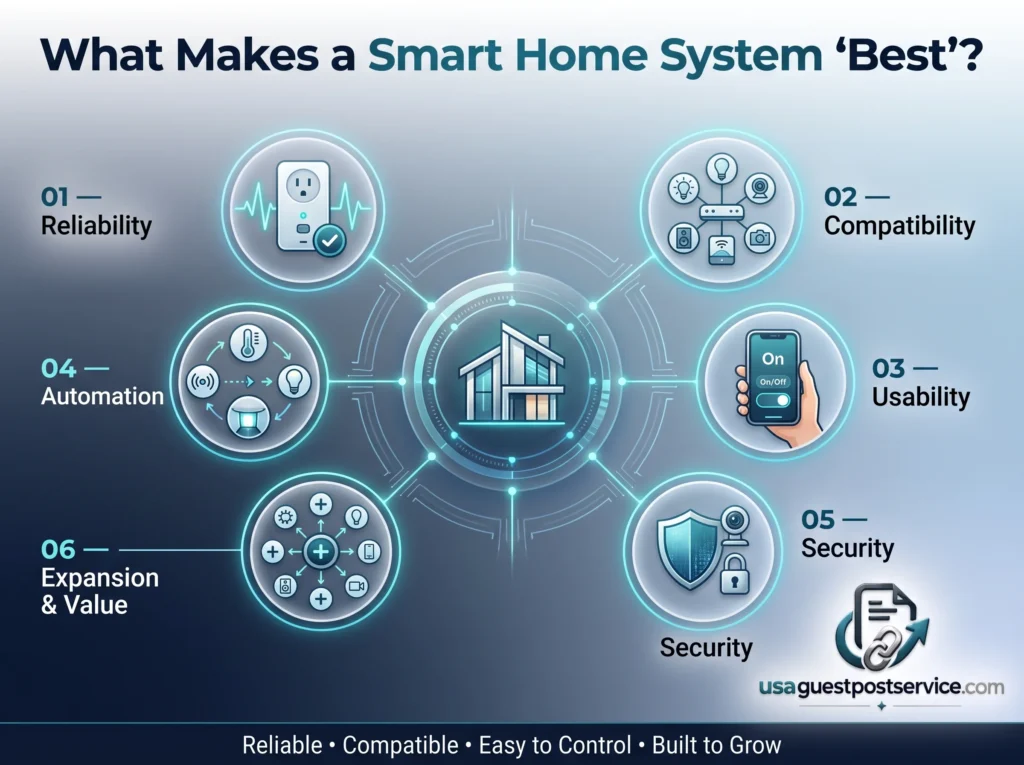
The best smart home system is one that is reliable, compatible, easy to control, secure enough for the household, and flexible enough to support realistic future needs.
A useful way to think about the decision is:
Needs → Compatibility → Control → Automation → Security → Expansion → Value
Each part affects the overall experience.
A system can have excellent devices but still be frustrating if those products require several unrelated applications. It can offer powerful automation but still be difficult to use if household members cannot easily override it. It can support hundreds of products but still be a poor fit if the few devices you actually want are not compatible.
For most homeowners, the strongest system is the one that makes everyday tasks easier while remaining understandable and dependable.
Reliability
A smart home system should work consistently enough that household members can trust it.
Lights should respond when controlled. Sensors should report expected events. Connected climate controls should remain accessible. Devices should not frequently disconnect or require repeated troubleshooting.
Reliability depends on more than the platform itself. Network quality, device placement, software support, compatibility, and configuration all contribute to the experience.
Compatibility
Compatibility determines whether the system can support the devices and functions the homeowner actually wants.
A product may be technically “smart” while still being unable to participate in the preferred platform, control method, or automation.
The best system should therefore be evaluated around specific use cases rather than general device counts.
Usability
A smart home should be understandable to the people who live in it.
If everyday functions require complicated menus or several applications, the system may create more friction than it removes.
Good usability usually includes clear controls, predictable behavior, and practical manual alternatives.
Expansion
Many smart homes begin small.
A homeowner may start with lighting and later add climate control, security, sensors, entertainment, or centralized control.
A good system should support realistic future growth without requiring the entire setup to be replaced.
Start With Your Smart Home Goals
Choosing the best smart home system should begin with household goals rather than technology.
A security-focused household may care most about cameras, locks, doorbells, sensors, notifications, and reliable remote access. A convenience-focused household may care more about lighting control, voice interaction, schedules, and simplified access to frequently used functions.
Comfort may be the priority for another home, where climate control, shades, lighting scenes, and environmental sensors matter more. Some homeowners may be interested in energy management and want better visibility or control over heating, cooling, lighting, plugs, or selected appliances.
Entertainment can also shape the system. A household that relies heavily on connected televisions, speakers, multi-room audio, or media controls may prioritize those functions over security or automation.
Accessibility is another important consideration. Voice control, centralized interfaces, remote access, and simplified physical controls can provide additional ways to interact with the home.
The best system therefore starts with one question:
What do you actually want the smart home to improve?
Choose the Right Type of Smart Home System
Smart home systems can vary significantly in complexity.
For most homeowners, it is useful to think in terms of three broad approaches: a simple device-based system, a platform-centered system, or an integrated whole-home system.
Simple Device-Based System
A simple system may consist of only a few independent smart devices.
A homeowner might use several smart lights, one thermostat, a video doorbell, and a smart speaker. Each product may have its own application, although some may also work through a shared platform.
This type of setup is often a good starting point because it requires less planning.
It works well when the household only wants to solve one or two clear problems.
The limitation appears when more unrelated devices are added over time. A home with many separate applications and no common control strategy can become difficult to manage even if every device works individually.
Platform-Centered Smart Home System
A platform-centered system organizes multiple compatible products within one shared control environment.
The platform may provide common device controls, scenes, routines, notifications, voice interaction, selected integrations, and shared access for household members.
This approach can make a growing smart home easier to manage because devices are no longer treated as completely isolated products.
For many homeowners, this is the practical middle ground between a few standalone devices and a much larger integrated system.
Integrated Whole-Home System
An integrated whole-home system can coordinate several technology categories across the property, such as lighting, security, climate control, entertainment, access, shades, sensors, centralized interfaces, and automation.
This approach can provide a more unified experience, but it also requires more planning.
Compatibility, network design, equipment locations, control methods, and future maintenance become more important as the system grows.
A whole-home system only makes sense when the household benefits from that additional coordination.
Best Smart Home Features to Prioritize
The best smart home features are the ones that improve everyday use rather than simply adding technical capability.
Reliable control should come first. Homeowners should be able to use apps, physical controls, voice commands, touchscreens, centralized interfaces, or automation where those methods are useful. A good system normally does not depend on only one way to control important functions.
Compatibility is equally important. A device should support the platform or controller you intend to use and provide the specific function you expect. Broad compatibility claims do not always mean every feature will work across every system.
Useful automation can also improve the experience, but only when it reduces repetitive actions without making the home unpredictable. Scheduled lighting, selected climate adjustments, notifications from sensors, scenes, or clearly defined automated responses can all be useful when they solve a real need.
Remote access and monitoring can be valuable for cameras, thermostats, locks, selected appliances, and other connected systems, but not every household needs every remote feature.
Security and privacy controls should also be easy to understand. The system should provide practical ways to manage user accounts, permissions, updates, device access, privacy settings, and connected services.
Finally, expansion should be considered from the beginning. A good system does not need to support every imaginable future product, but it should not unnecessarily restrict realistic future additions.
What Is the Best Way to Control a Smart Home?
There is no single control method that is best for every task.
The strongest smart home control strategy usually combines several methods.
| Control Method | Best For | Main Limitation |
| Mobile App | Remote access and detailed settings | Can become cumbersome if too many apps are needed |
| Physical Controls | Fast everyday use | Less flexible than digital interfaces |
| Voice Control | Quick hands-free commands | Not ideal for every task or environment |
| Central Control Panel | Managing several connected systems | Requires more planning and may add cost |
| Automation | Repeated predictable actions | Poorly designed automation can become frustrating |
Mobile applications are useful because they provide access to detailed settings and remote controls. However, an app-only smart home can become inconvenient. Household members should not need to unlock a phone every time they want to turn on a light.
Physical switches, buttons, thermostats, and other familiar controls remain valuable because they provide an immediate interface and make the home easier to use for guests or household members who do not regularly use smart-home apps.
Voice control can make quick commands convenient, particularly for lighting, entertainment, or selected settings, but voice usually works best as a supplement rather than the only control method.
Larger systems may benefit from a centralized interface that provides access to several connected functions without moving between multiple applications.
Automation can remove the need for manual control in selected situations.
The best approach is usually a combination of manual, digital, and automated control, with each method used where it makes the most sense.
How Much Automation Do You Actually Need?
The best home automation technology is not necessarily the most complex system available.
Automation is useful when it handles predictable tasks.
A household may benefit from lighting schedules, selected climate adjustments, sensor-based notifications, or simple routines tied to regular activities.
Problems can appear when automation becomes difficult to understand.
A routine that behaves unexpectedly when household behavior changes can quickly become frustrating. That is why good automation should remain understandable, predictable, easy to override, and connected to a real household need.
Manual control should remain practical.
If an automation fails, household members should still be able to perform the underlying function without troubleshooting the entire smart-home system.
Compatibility Is More Important Than Feature Count
One of the easiest mistakes when choosing a smart home system is focusing on the number of supported products.
A platform that claims broad compatibility may sound attractive, but the real question is whether it supports the specific devices and functions you intend to use.
Compatibility can depend on the device model, product generation, software platform, communication technology, hub requirements, account integrations, and the exact feature involved.
A camera may work with a platform for basic viewing but not support every advanced function. A thermostat may provide temperature control while excluding certain automation features. A lock may integrate with one control method but not another.
The best smart home system is therefore not necessarily the one with the largest device catalog.
A smaller ecosystem that fully supports the household’s important functions can be more useful than a larger ecosystem with inconsistent feature support.
Privacy, Security and Reliability Considerations
A smart home system can involve cameras, microphones, access controls, sensors, accounts, cloud services, and household data.
That makes privacy and security part of the selection process.
Homeowners should consider how accounts are protected, whether multi-factor authentication is available, how device permissions are managed, how often products receive updates, whether important functions depend on cloud services, how access is shared with household members, and what happens when internet access is unavailable.
Reliability also matters.
A smart home should not become unusable because one external service is temporarily unavailable.
Where practical, frequently used household functions should retain straightforward local or physical control.
Network quality is part of reliability as well. A good platform cannot compensate for poor connectivity where devices are installed.
Best Smart Home System for Beginners vs Advanced Users
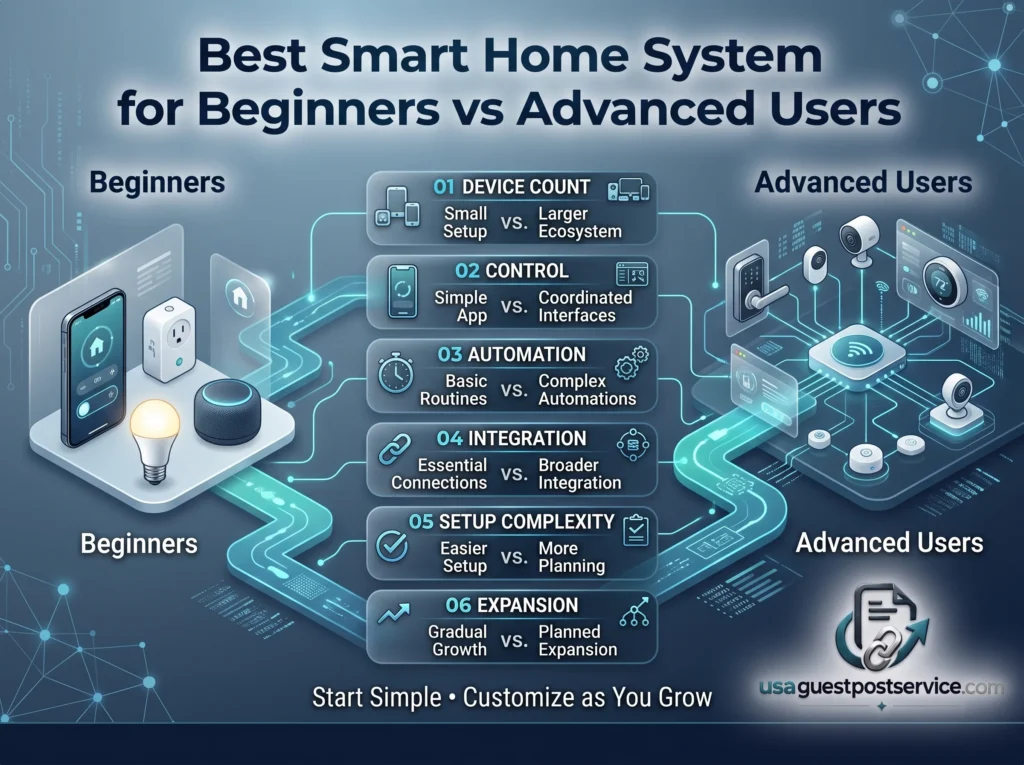
The best system for a beginner is usually defined by simplicity, while an advanced user may benefit from broader control, integration, and customization.
The difference is less about “better” technology and more about how much complexity the user is prepared to manage.
| Area | Beginner System | Advanced System |
| Device Count | Small | Larger |
| Control | Simple app and physical controls | Multiple coordinated interfaces |
| Automation | Basic routines | More complex automation |
| Integration | Limited | Broader |
| Setup Complexity | Lower | Higher |
| Expansion | Gradual | Planned more systematically |
Beginner Systems
Beginners generally benefit from simplicity.
A good starting system may focus on one or two clear goals and use a small number of compatible products.
This gives the homeowner time to understand how devices behave, how reliable the network is, which controls feel convenient, whether automation is useful, and which additional features are actually needed.
Advanced Systems
Advanced users may want several device categories to work together.
That can increase the need for stronger network planning, centralized control, broader compatibility, structured automation, detailed user permissions, and better system documentation.
The right level of complexity depends on whether those additional capabilities provide meaningful value.
How to Compare Smart Home Systems Before Choosing
Before committing to a smart home system, evaluate it against the household’s actual requirements.
A useful checklist is:
- What problem am I trying to solve?
- Which devices do I actually need?
- Are those devices compatible with the system?
- How will household members control it?
- How much automation is useful?
- What happens if the internet is unavailable?
- What privacy and security controls are provided?
- Are subscriptions required?
- Can the system expand later?
- How difficult will maintenance be?
- Does the additional functionality justify the cost?
This process helps separate genuinely useful features from marketing.
It also reduces the risk of building a system that looks impressive but does not fit the household.
What Is the Best Value Smart Home System?
The best value smart home system is not necessarily the cheapest.
Value comes from getting useful functionality without paying for complexity or features that will not be used.
A lower-cost system can offer better value if it reliably supports the household’s core needs without requiring unnecessary subscriptions, accessories, or platform changes.
For example, a household that only wants lighting and climate control may not benefit from investing in a large integrated control system.
A household with several rooms, multiple connected systems, and more complex control needs may find centralized management worth the additional cost.
Value should be judged by usefulness, reliability, compatibility, maintenance needs, subscription costs, expected lifespan, expansion potential, and ease of use.
The best value smart home technology is the technology that continues to provide practical benefits over time.
Best Ways to Make Your Home Smarter
The best way to create a smart home is usually to start with a small number of useful improvements rather than trying to automate the entire property immediately.
Step 1: Define One Useful Goal
Choose a clear problem, such as lighting control, entry monitoring, temperature management, entertainment, or another household need.
Step 2: Choose a Compatible System Approach
Decide whether the need can be handled by one device, a shared platform, or a broader system.
Step 3: Start With Essential Devices
Add only the products required to solve the initial problem and confirm that the controls and connectivity work reliably.
Step 4: Test and Expand Gradually
Use the system in daily life, then add new devices or automation only when they provide a clear benefit.
For a more detailed implementation process, our how-to set up a smart home guide covers planning, devices, connectivity, and setup in greater depth.
Common Mistakes When Choosing a Smart Home System
Choosing a smart home system can become unnecessarily complicated when decisions are based on features rather than needs.
Choosing by Feature Count
More features do not automatically create a better system.
Unused features add complexity without adding value.
Mixing Incompatible Devices
Buying products individually without considering compatibility can lead to fragmented controls and limited integrations.
Ignoring Network Quality
Connected devices depend on reliable communication.
Poor Wi-Fi or network coverage can make an otherwise good system feel unreliable.
Relying Only on Voice Control
Voice can be convenient, but it should not be the only practical way to control important household functions.
Creating Too Much Automation
Too many overlapping routines can make system behavior difficult to predict.
Automation should simplify the home.
Ignoring Manual Fallbacks
Important functions should remain usable when an app, internet service, or automation is unavailable.
Ignoring Privacy and Security
Account access, permissions, updates, and connected services should be reviewed before the system becomes large.
Buying for an Imaginary Future
Future expansion matters, but purchasing expensive equipment for scenarios that may never happen can reduce value.
Plan for realistic growth.
Frequently Asked Questions About the Best Smart Home System
What is the best smart home system?
The best smart home system is one that matches the household’s needs, supports the required devices, provides practical controls, remains reliable, and can expand without unnecessary complexity.
There is no single system that is best for every home.
What is the best smart home system for beginners?
A simple system with a small number of compatible devices is usually easier for beginners.
Start with one clear goal, learn how the devices behave, and expand only when additional technology provides useful benefits.
What features should a good smart home system have?
Useful features include reliable control, device compatibility, practical automation, remote access where needed, understandable security settings, and the ability to expand.
The exact priorities depend on the household.
What is the best way to control a smart home?
The best approach is usually a combination of mobile apps, physical controls, voice interaction, centralized interfaces, and automation.
Different control methods are better for different tasks.
Is a fully automated smart home better?
Not necessarily.
A fully automated system can become difficult to understand if routines are too complex.
A simpler system with useful automation and clear manual controls may provide a better experience.
Should I buy all smart home devices from one brand?
Not always.
Using products from one ecosystem can simplify compatibility, but brand consistency is less important than whether the devices support the functions and control methods you actually need.
Is the most expensive smart home system the best?
No.
Higher cost may provide more features, equipment, integration, or professional support, but those additions only provide value when the household needs them.
How do I know if a smart home system is worth it?
Compare the system’s usefulness, compatibility, reliability, maintenance, ongoing costs, and ease of use against the problems it solves.
A smart home system is worthwhile when its benefits remain useful beyond the initial novelty.
Conclusion: The Best Smart Home System Fits the Home
There is no universal best smart home system.
The right system depends on the household’s goals, devices, preferred control methods, automation needs, privacy expectations, budget, and future plans.
For some homes, a small platform-centered setup provides everything needed.
For others, a larger integrated system may provide better coordination across lighting, climate control, security, entertainment, and other technologies.
The most important decisions happen before the system becomes complex.
Start with clear needs, confirm compatibility, choose practical controls, keep automation understandable, consider security and reliability, and expand only when additional technology provides real value.
The best smart home system is not the one that makes the home look the most advanced.
It is the one that makes everyday household functions easier to control, easier to understand, and more useful over time.